Monday, June 28, 2010

No. 15, Bloom

As many who are close to me know, my maternal grandfather, who I refer to as my Popi, passed away this past Thursday, June 24, 2010.  While his health had been deteriorating for quite some time, such does not change the fact that his death was not only untimely but also painful.  Words cannot even begin to express how much my Popi means to me and, furthermore, how grateful I am for all that he has done for me in my life.  He personifies the ideal man-- the perfect representation of all that is good and beautiful in the world.  As a survivor of the Holocaust, it would be an understatement to say that he suffered the greatest atrocity known to mankind.  Yet more importantly than surviving such a horror, my Popi continued to live, to strive for greatness, to achieve his dreams and a better life.  He is an inspiration to us all.

This was my first true experience with death.  I have never had a family member pass away at an age when I could properly comprehend as well as feel the burden and sorrow of the situation.  It is almost surreal, yet in the worst way possible.  I have yet to fully accept the situation; it is so hard to believe that he is physically gone.  However, perhaps his absence is so difficult to believe because of his strong presence in my heart and soul, because of the fond memories I carry of the times we had spent together.  Such recollections make him immortal, not only for me but also for my entire family who collectively share the weight of his passing.  Popi will always be missed, eternally remembered, forever cherished.

Here is the eulogy I shared yesterday morning at his funeral:

Thank you all so much for being here today for me, my family, and my Popi.


Marcel Proust, a French novelist, once wrote: "Let us be grateful to people who make us happy; they are the charming gardeners who make our souls blossom."  My Popi was one of these charming gardeners, who with his hands and heart shaped our world and our souls in which he lives eternally. I can say without hesitation that I am grateful not only for all that Popi has ever done for me but also for being so blessed to have him as a part of my life.


My Popi was and will always be a source of happiness; his kindness, laughter, and generosity humbly reflected the mensch he exemplified throughout his life. He often reminded me that I should strive for success, but, most importantly, that I should be happy with and passionate for what I do, who I love, and who I am.


For me, my Popi is a flawless representation of mental and emotional strength; after all that he had suffered and experienced, he chose to rise above and embodied grace, warmth, and sagacity-- all qualities that I feel have been passed on to me by example.


So let us all be grateful to my Popi and always remember him for the happiness he has inspired within us all and for making our lives thrive and bloom into brilliant gardens of love, spirit, and radiance.


Popi
September 22, 1922 - June 24, 2010

Thursday, June 24, 2010

No. 14, "Partons Vite"

Un petit post sur la musique.


Few things frustrate me more than restlessness.  When I find myself in such a state, I often pull my current read out from under my pillow where it is placed for safekeeping while I dream at night.  Tonight, however, I am far too mentally exhausted to comprehend or extract meaning from the written word.  I choose music. Finding a song at a late hour has always been a daunting task: choose one too exciting and one might inadvertently preserve the agitated state; choose one too boring and one will most likely transfer one's concentration and anticipation to the awaited ending of the song rather than the real task at hand, sleep.


Listening to Joshua Radin at night has produced varied results.  Oftentimes, I will drift off into romantic imaginings of a far-fetched love affair, or even friendship, with the troubadour who essentially embodies my vision of the perfect man. I have a 50/50 chance of either slipping into a deeper state of delusion, a slumber cushioned by the gentle tones of his voice in the distance, or simply letting my imagination run wild with such fantasies-- as pathetic and excessive they may be. One of the songs released on his latest EP, "Streetlight," is so beautiful--like all of his ballads--that I have set a limit to the number of times I can listen to it on a given day.  After twenty years, it seems that I still haven't quite achieved an effective way of curbing my obsessive compulsions. I still maintain that there is nothing wrong with passion.

Feist is normally the perfect solution-- the perfect mixture of soothing beats and softly woven words to encourage my mind to surrender to the heaviness of my eyelids, i.e.  "Gatekeeper," "The Limit to Your Love," and, my personal favorite, "So Sorry." Her voice is hauntingly beautiful, and the fluidity of the tracks in her albums makes it easy to fall under her spell whether wide awake or dozing off. Yet, to my dismay, Feist's ballads and melodies have lost their effect in inducing sleep; my mind has mastered its predicability and, for once, has discovered that familiarity has its disadvantages.

In short, I have been in need of a new song to lead me into a state of reverie that consequently ushers me into "dreamland." And to my surprise, this evening I found such a tune.  Oddly enough, I do not even remember purchasing it, nor do I remember it being offered to me as a casual recommendation.  Yet as I was skimming my iTunes library just thirty minutes ago, I came across "Partons Vite" by Kaolin, a French rock band. The lyrics are simple yet moving, and the melody is simultaneously catchy and calming. Wherever it came from, I am glad it settled in my collection, for it is certainly here to stay.

I will end this unusually brief post with the lyrics and a recommendation of my own: give it a listen.

Allez danse, danse, vient dans mes bras,
Allez tourne, tourne, reste avec moi,
Allez partons vite si tu veux bien, dès le jour,
Le soleil brille très haut tu sais,
Mais j'aime ça, je t'attendais
Alors partons vite si tu veux bien, sans retour...

Rit plus fort et parle-moi
De nos projets, de nos rêves tout ça
Donne-moi la main, embrasse-moi, mon amour
Le temps comme ami, moi je veux bien
Mais les amis ça va, ça vient,
Alors partons vite brûler le jour et la nuit

Evidemment, tu l'aimes encore,
Je le vois bien tu sais, et puis alors?
Mais pour l'instant ferme tes yeux, passe ta main dans mes cheveux.

Je veux entendre, ton coeur qui bat, tu sais, je crois qu'il chante pour moi
Mais en douceur comme ça tout bas, comme un sourd
Mon coeur lui s'emballe, il vole haut, peut être un peut trop haut pour moi
Mais je m'en fou, je suis vivant pour de bon

Allez danse, danse, regarde-moi
Allez tourne, tourne, ne t'arrête pas
Allez partons vite, si tu veux bien, dès le jour
Le soleil brille, profitons-en
Je t'attendrai, je t'aime tant
Alors vas-t'en vite si tu veux bien, sans retour

Evidemment, tu l'aimes encore,
Ça crève les yeux mon dieu, tu l'aimes encore
Mais pour l'instant ferme tes yeux, passe ta main dans mes cheveux

Allez danse mon amour! Allez danse!
Faisons de nos enfants des droits!
Fait tourner le monde mon amour, fait tourner le monde

Allez danse, danse, retourne-toi
Allez tourne, tourne, ne t'arrête pas
Allez partons vite, si tu veux bien, dès le jour
J'ai manqué d'air je m'en souviens,
Toutes ses années sans toi sans rien
Même mes chansons se baladaient le coeur lourd

Evidemment, tu l'aimes encore,
Ça crève les yeux mon dieu, ça crève les yeux mon dieu
Mon dieu...

Friday, June 18, 2010

No. 13, La Richesse du Monde: Architecture

Architecture is formally defined as the art or practice of designing and constructing buildings.  In my opinion, the discipline can be more intimately described as an interpretation, an image, a mode of expression, for architecture is—above all things—a reflection of the architect and the setting—both the location and the era.  Oftentimes, when viewing a structure, we do not go past its aesthetics, its visual appeal, and, in doing so, we sacrifice the deeper understanding and appreciation we could obtain by choosing to delve deeper into the building’s history and value to society.  Of course this does not mean that one should ignore the explicit beauty of a site; I, for one, am often guilty of basing my judgment on such qualities.  However, after detecting such allure and elegance, I would like to suggest that one should take this recognition a step further by asking oneself, “why do I find this beautiful?  In studying and exploring architecture—as well as film, art, music, etc—we owe it to ourselves—as well as the architects, directors, artists, and musicians—to sincerely analyze that which entices and intrigues us with the hope of grasping a more profound understanding of our passions and their value to our lives.

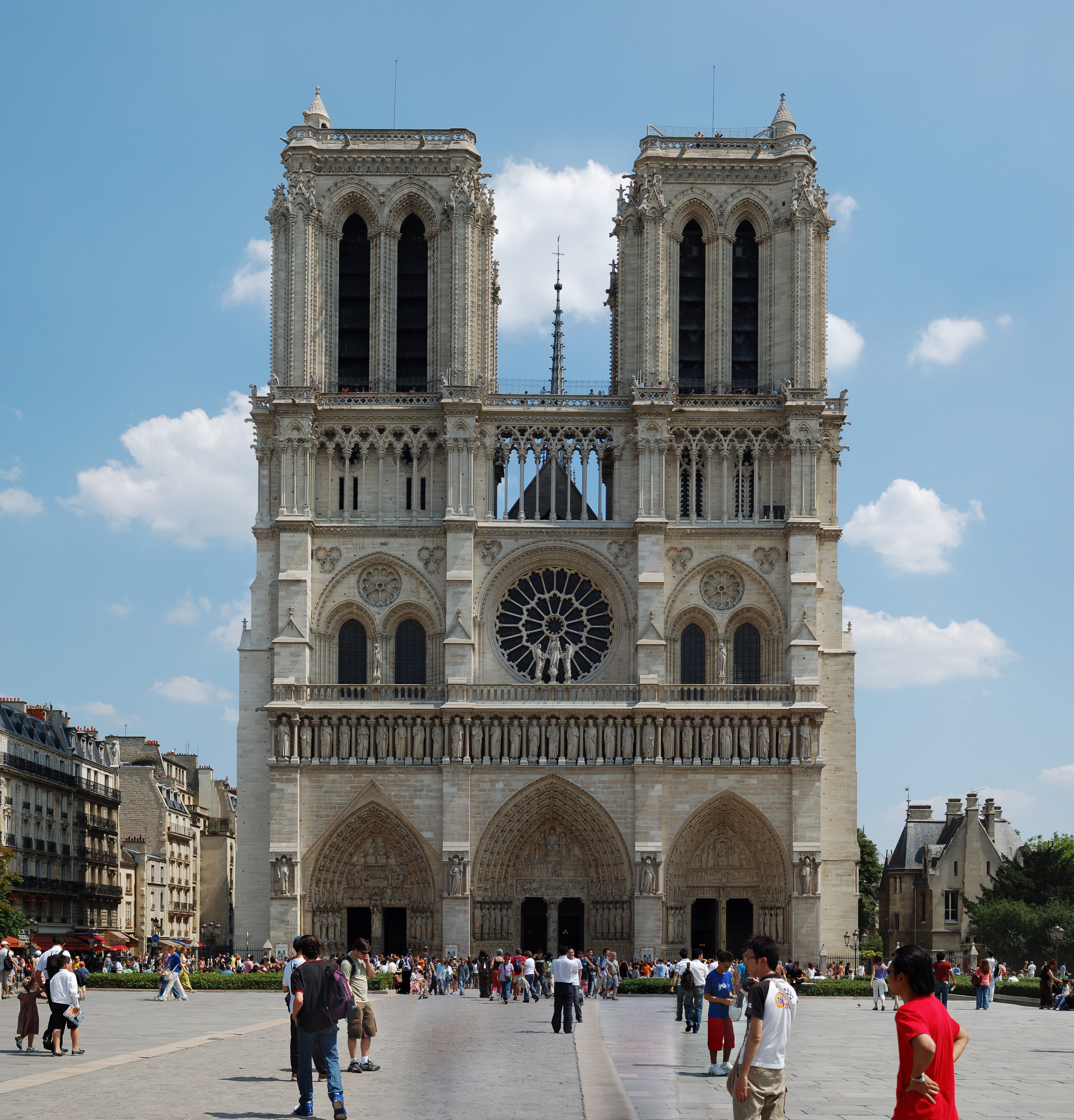
In the two years that I have formally studied architecture, I have soaked up what I believe to be a considerable amount of knowledge on architectural form and function.  Each building and architect offers its own unique agenda, providing a distinctive design and a discrete human experience.  The “human experience” is just as much what we get out of our visit to a building as the intentions of the architect through the supplied human factors of the structure.  For example, one might ask, “when visiting Notre-Dame de Paris, how can one avoid the feeling of being dwarfed by the scale of the cathedral?  Being “dominated” by Notre-Dame is as important as being embraced by the cathedral.  One can tell immediately by the size of the three entry portals that the space in which he or she is about to enter will be one of immense and impressive size and scale—no doubt about it.  Such conclusions are confirmed after accessing the interior, where one finds himself amid sky-high vaulted ceilings, colossal chandeliers, majestic stained-glass windows, and columns of a thickness similar to that of a Redwood tree.  It is true that if the exploration of this national treasure ends here, in the areas of the nave and sanctuary, one could easily assume that the cathedral’s primary goal—other than religious inspiration and international acclaim—was to diminish the value of the intimacy of the religious experience.  This is, in fact, a valid thought. The religious experience Notre-Dame de Paris was aiming for was one that emphasized the unity of a congregation through devotion to G-d rather than that of a personal bond. The simplicity of the individual wooden chairs that make of the pews of the nave assert the desire for the congregants attention to be directed towards the grandeur and unrivaled splendor of the cathedral, an example of elegance and glory that could be outmatched only by the Supreme Power.

During my last trip to Paris in late July 2009, I was resolved to visit Notre-Dame de Paris, despite the tourist trap, and, furthermore, to brave the climb to the top.  After entering the cathedral, my group of twenty-or-so visitors was ushered into the gift shop before the trip up.  Ready for our climb, we began the trek, greeting each of the 387 steps with exaggerated breathing.  While it was not a difficult climb per se, the 387 steps were arranged in a continuous, tight spiral—similar to those at the Arc de Triomphe—throwing me slightly off-balance from time to time and forcing me to take a break every now and then.  This climb put new meaning in “communal experience” as I found that I was not the only one suffering from periodic dizzy spells.  However, the staircase was only wide enough for one person; thus, before being used for “the Tower tour,” the climb was a chiefly individual—and seemingly never-ending—experience, almost simulating the ascension to the heavens.

Upon arriving at the top, the “observation deck” and pathways between the towers further insist the experience on a personal level.  Aside from the impressive size of the bells and the statues of the twelve apostles that decorate the spire, one is able to interact with the gargoyles, disturbing as they may be, and appreciate the detail of the cathedral’s construction.  Yet, this sort of appreciation differs from that inspired by the cathedral’s interior, for here, atop the famous structure, one can interact with the design, feel the materials, view the ornamentation under natural light and without the grand distraction of the gorgeous stained-glass, exquisite paintings, and stunning organs.  From this viewpoint—both physical and mental—the experience becomes less religious and more focused on spotlighting the home of the cathedral, Paris, providing panoramas that, in my opinion, surpass those offered by the Tour Eiffel.  To some, such an outlook may, again, dwarf the viewer, forcing him or her to feel almost microscopic within the density and monumentality of Paris.  However, I seized this moment; while standing atop one of the most famous and most beautiful cathedrals in the world, I saw Paris from a height where I could distinguish one area from another, pick out a bookstore I had perused while also note Sacre-Coeur, Montparnasse, and La Défense with a very slight turn of my head. Standing alone and far away from the hoards of tourists, I soaked in the intentions of the original anonymous builder, Pierre de Montreuil, and, later, Eugène Viollet-le-Duc (among others) in shaping their desired “human experience.” I felt, in my moment, a sort of confirmation of my presence in Paris; I knew exactly where I was and what, one day, I could be a part of—a city that simultaneously inspired and comforted me despite the almost 5,000-mile distance from home. While there are plenty of places one can escape to in Paris, few astound and take one aback like Notre-Dame with its periodic moments of intimacy amid such glory and resplendence.


During the 384 steps back down to ground level, I sensed a gradual return to reality, a gravitational pull towards the world of which I was a part, like a unit that would re-establish the balance that had been altered during my ascension.  I arrived at the bottom and, as I exited, I greeted the façade of Notre-Dame once again, confirming my achieved understanding of not only the cathedral’s inspiration to artists, writers, and architects but also, then more than ever, the power of architecture.

Sunday, June 13, 2010

No. 12, Anticipation

It is hard to believe that in less than three months I will be leaving for my year-long stay in Paris and embarking on a journey--both physical and mental--that is sure to change me as a person.  Aside from time itself, all that stands in my way is: the purchase of an airline ticket, the finalization of the visa process, and the completion of my two online biology courses.

Anticipating my year abroad, I cannot help but think back on my first experience leaving home.  As you all know by now, this great step was not taken until the summer before my senior year of high school-- a bit late in comparison to my other friends who had braved sleep-away camp summer after summer.  Overwhelmed with excitement and exhilaration, I failed to acknowledge my fear and anxiety, assuring myself that I was sufficiently both mature and prepared.

A few days before departing, my mother and I met my French teacher--more accurately, mentor and inspiration-- for a café to discuss my upcoming experience and share last minute advice.  Mr. Azzi warned me about my French-size room and the inevitable struggle of speaking French "under pressure"-- prompting the fear of being dependent on a language other than my mother tongue.  "You should expect, when you arrive, that you will be upset, probably cry, and be very homesick.  Just know that this is just the jet-lag and that upon waking up the next morning, you will regret feeling the way you did the day before-- I promise."  I shrugged off Mr. Azzi's advice saying, "I am too excited for that to happen!"  But of course, Mr. Azzi knew all too well that I was only fooling myself.

 Upon arriving in Nice, I was certainly tired, yet I was immediately energized by the breathtaking panoramas of the city spotlighted by the windows of the autobus.  We arrived at our lycée, Lycée Masséna, and as I stood in the check-in line, I began to feel the first signs over overwhelming fatigue, which I boldly fought through the three-story climb to my room whilst carrying two overfilled duffle bags.  I found my room and nudged open the door only to find that my room was more than twice as bare and tiny as I had imagined.  I proceeded to break down.  I phoned my mother bawling, begging to come home, and insisting that I was assigned to the worst living situation possible.  Naturally, my mother was beside herself; not knowing what to do or how to help, she consoled me as best she could reminding me of how long I had been looking forward to this experience and pleading that I give it a chance.  I hung up the phone and rushed to dinner so that I could return to my prison cell as soon as possible.  I spoke to a few people who seemed to be far less upset than I was; yet I sulked back to my room still longing to return home to my comfort zone.

I opened my window to find a quaint view of Nice-- my school, some picturesque houses, and a lush landscape of deep greens and blues.  It was quite stunning, and I began to feel a bit of comfort in this foreign setting.  A few minutes later, my portable rang, flashing a number I did not recognize.  I picked up the phone with a shy "allo?" and, to my surprise, I heard a familiar voice on the other end: "Lisa? This is Mr. Azzi. You didn't believe me, did you?"  My fear and sadness turned to anger, and I began to shout at and complain to Mr. Azzi, cursing him for "forcing" me into such an experience-- essentially telling him that I hated him and blaming my emotions solely on him.  "Your mom called me freaking out, saying that you wanted to come home and hated everything... so I told her I'd take care of it."  I told him that he was not mistaken.  Yet after a brief conversation and some words of encouragement, Mr. Azzi had said enough to calm me down and to make me agree to going to sleep and starting anew tomorrow.

Just as Mr. Azzi had promised, I woke up the next morning refreshed, reinvigorated, and ready to embark on my six-week adventure along the Côte d'Azur.  I could vaguely recall the tears and howls I released the night before, and I was thoroughly ashamed of myself.  How could I so prematurely and cruelly reject the beauty and splendor of Nice?  Such blasphemy compelled me to immerse myself in French language and culture even more than I had originally planned.  I breathed in the scent of the Mediterranean, imbibed a delectable diabolo fraise, sampled the life-changing ice cream of Fenocchio, and confidently conversed in French with anyone who was willing to embrace my frequent mistakes.  I met some amazing people, greatly improved my oral and written French, and developed as an individual more than I could have ever imagined.  One could say that I was "sold" after this experience; I knew I would go on to major in French and, one day, be a French professor.  I am proud to say that I am still on this journey and am still as passionately determined to follow through with this aspiration.

This time around, I anticipate the fear I will experience upon arriving in Paris and the desire I will feel to return home every now and then.  I hope that going into this experience with this understanding and acceptance will ease the transition into this new chapter of my life.  Ever since I returned home from Nice in August 2007 and, more recently, from Paris in August 2009, I have been anxiously awaiting this year abroad.  I have never been so excited about or scared of anything-- feelings I have come to understand and consider as healthy and essential to the human experience (or at least to my own).  If a year in Paris opens my eyes and emotionally shapes me even half as much as Nice did in only six weeks, I think I can safely say that I expect to truly find myself and the person I hope to be in the future-- a revelation to which I wholeheartedly look forward.

Monday, June 7, 2010

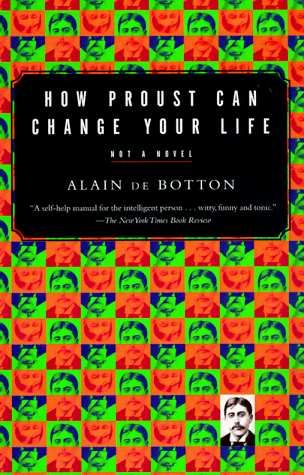
No. 11, "How Proust Can Change Your Life"

Last year for my birthday, my best friend Juliette presented me with a book titled The Architecture of Happiness, the second non-fiction work written by Swiss writer, Alain de Botton.  Whether or not Juliette was aware of its literary success, The Architecture of Happiness was the perfect gift for me as an architecture admirer and literary devotee.  The book discusses the way in which architecture and its beauty affect us and our well-being-- both as individuals and as a society.  In my architecture courses, I have always been concerned with this concept: the role of architecture and the built environment in shaping an identity.  While conducting research on the architectural designs of Paris and Algiers under the reign of Napoléon III, I aimed to prove that the reformations of these cities solidified the desired identity of the French empire as well as the intentions of Napoléon III as an emperor.  In The Architecture of Happiness, Alain de Botton validates the power of architecture, yet he presents his argument with such poise and graciousness, which, in my opinion, writers often lack.  After reading this book, I felt the sense of general contentment for which Botton had clearly aimed, almost as if he had authenticated my own views of architecture and its potency that is somewhat unacknowledged by the common man.  I imagine that I would have eventually purchased this book somewhere down the line, but I am truly grateful that Juliette expedited this acquisition.

Alain de Botton's first non-fiction work is titled How Proust Can Change Your Life. This book has been on my reading list even since I completed The Architecture of Happiness, yet it had remained overlooked until this past Thursday evening when I found myself at Barnes & Noble while browsing the "Essays" section.  Just two shelves above literary luminary, David Sedaris, I saw the all-too familiar cover of The Architecture of Happiness beside How Proust Can Change Your Life, a funny-looking paperback with green- and orange-tiled images of Marcel Proust, a renowned French novelist and essayist.  This welcomed confrontation forced me into purchased the book, which I eagerly began upon returning home.

In How Proust Can Change Your Life, Alain de Botton addresses Marcel Proust--both his works and his life-- in a way that provides both reflections on the writer as well as offers advice and "self-help" based on de Botton's thoughts on Proust and his value to everyday life.  I guess the title should have given away its "self-help" agenda, yet, halfway through the book, I have found myself as enveloped in de Botton's words as the plot of any fiction piece, hanging on his every word and devouring the quotations provided from Proust's works and critiques.

Marcel Proust (or, Valentin Louis Georges Eugène Marcel Proust) is best known for his seven-part semi-biographical oeuvre À la recherche du temps perdu (In Search of Lost Time), which totals in 3,200 pages-- of which I have only read several excerpts.  This project began in 1909 and ended with Proust's death at the age of fifty-one in 1922.  Proust is described as a man who lived for detail, valuing the minutia to be equal, if not more precious, than the "plot-summary" points.  In the chapter of How Proust Can Change Your Life that is appropriately titled "How to Take Your Time," de Botton discusses Proust's conflict with reading the newspaper-- more specifically, the "news-in-brief" section-- for he felt that condensing a story to such a great degree undermined and damaged its events and their importance, compelling Proust to imagine the "bigger picture" for himself--however accurate or faulty it would be.  De Botton writes, "it shows how vulnerable much of human experience is to abbreviation, how easily it can be stripped of the more obvious signposts by which we guide ourselves when ascribing importance."  I find this so profound-- probably because it is true.

Clearly the length of Proust's works boldly represent the extreme opposite on this spectrum of detail, a quality that both deterred (and still deters) readers as well as induced praise from critics who cited Proust as a "literary genius."  While I myself have not braved the immensity of À la recherche du temps perdu, I hope to do so one day.  Nevertheless, I do value Proust's strive to spotlight and emphasize the significance of small details and trivialities, from the annoyance of restlessness to the particularities of one's morning routine.  After all, these aspects shape us-- our identities.  Although whether we comb our hair before brushing our teeth (or vice versa) may not share any insight on our value as human beings, it certainly reveals how one person is different from the next in an infinite number of ways.  These minor distinctions and variations remind us of how beautiful we are in our own respective ways and should, hopefully, make us step back and recognize the grace and wonder we can find in one another.

De Botton, Alain. How Proust Can Change Your Life. New York: Vintage International, 1997.

Thursday, June 3, 2010

No. 10, "Fenocchio"

As I have been preparing for my year in Paris, I have also been reflecting on the times I have spent in France in my recent past.  I can go on for hours talking about the architecture of France and the multitude of cathedrals and museums I have visited out of personal interest.  However, for those who are neither francophiles nor architecture enthusiasts, I find it difficult to engage my listener, who often struggles to connect to my passions although he or she certainly acknowledges my enthusiasm.  Can one truly do Notre-Dame de Paris justice when describing the cathedral to one who has never seen its grandeur?  Can one successfully capture the feeling of wandering through the streets of Paris and translate such an experience into something that resembles a "five-minute pitch?"  I say no, especially considering the profusion of books written on just these two subjects.  Yet, I have found that every listener can be easily captivated by a certain subject, one that anyone and everyone can relate to: ice cream.

Aside from those that are lactose intolerant (though I am certain they dream of ice cream just as much--if not more--than everyone else), who doesn't love ice cream?  Looking back on my childhood, many of my fondest memories involve ice cream; all birthdays are honored with an ice-cream cake, and "chinny" (the name I assigned ice cream as a toddler) is used to celebrate successes and awards as well as rectify upsets and misfortunes.  But, of course, ice cream also fills the in-betweens of my life (and that of my mother and sister), giving it a sort of magical power to improve or enhance any and every situation.

I made my first extended journey away from home in the summer of 2007 when I participated in a language immersion program in Nice, France.  It was a big step for me, and made my commitment to French clear to my friends and family-- an allegiance that still holds strong.  While the separation from ice cream for the summer was certainly not a big issue, as a family tradition, it was hard to put in perspective what it would be like to leave everything behind.  All my friends had gone to sleep-away camp from a young age, but I never had such an experience, so as a seventeen year-old girl, it was a strange concept to wrap my brain around.


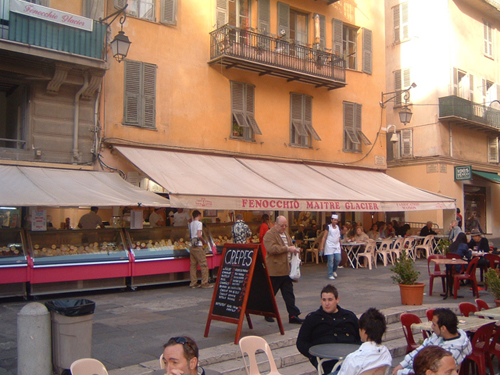
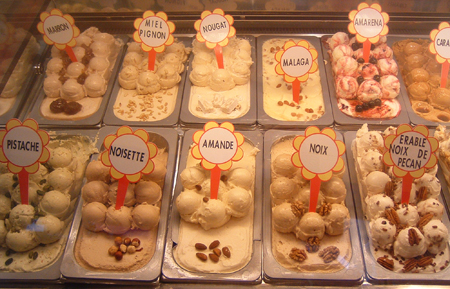
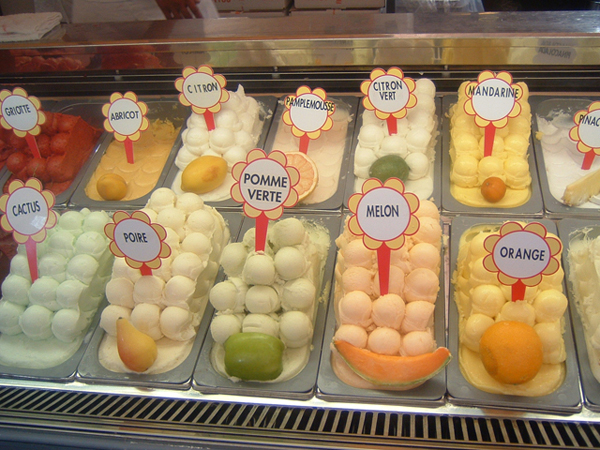
Shortly after arriving in Nice, I made my first pilgrimage to Fenocchio, a glacier (or, ice cream shop) in the Old City of Nice-- Place Rossetti, to be exact.  This visit was the beginning of a love affair.  From the  59 ice creams and 35 sorbets-- totaling in 94 flavors--I chose Ferrero Rocher and Nutella as my first gift to my taste buds, which were completely and utterly satisfied.  During my five weeks in Nice, I frequented Fenocchio at least once a day and defended my visits by the size of the scoops, or boules, and the opportunity it gave me to practice my French-- so witty, I know.  I am almost positive that I sampled every flavor by the time my séjour in Nice had come to a close (except for banane, chewing-gum, and bière).  If I had to name my top five favorites, I would choose: Ferrero Rocher, Nutella, Noisette, Pistache, and Fruit de Passion... but then I would have to mention Café, Poire, Pèche, Fraise Tagada, and Framboise.  Honestly, you can't go wrong.


When it was time to return to Texas, I was sad to leave my friends, la France, and, bien sûrFenocchio, a place that I continue to dream about until this day and often speak about with friends and family-- all of whom are anxious to visit this glacier that I have made out to be some sort of "heaven," which it most certainly is.  Even though I resumed my traditional trips to Baskin Robbins with little hesitation, I always remind myself of the happiness I found in the tiny boules de glace and the moments de bonheur at Fenocchio, and I anxiously await my return to Nice at some point during this coming year where I plan to relive this life-altering experience that ultimately contributed to the richesse de mon monde.