Tuesday, August 10, 2010

LA RICHESSE DU MONDE HAS MOVED!

Attention all readers: LA RICHESSE DU MONDE HAS MOVED!

It has been a good run with blogger, but I have recently converted my blog to Wordpress.

I would like to thank you all for reading my posts and hope that you will continue to do so.  I will be leaving for my year abroad in Paris in three short weeks, so exciting posts and reports are soon to come!


Love to all and happy continued reading!

xo

Monday, August 2, 2010

No. 21, How This Summer Has Changed My Life

I sincerely apologize for the long break since my last post just a tad over a week ago.  I will be taking yet another break this week as I am going to Florida on a much-desired five-day vacation.

However, I would like to take this opportunity to sum up several parts of my summer-- a thought that was inspired by several quotes from Marcel Proust (more specifically, from my "bible," Alain de Botton's How Proust Can Change Your Life).


Sometimes in the afternoon sky, a white moon would creep up like a little cloud, furtive, without display, suggesting an actress who does not have to "come on" for a while, and so goes "in front" in her ordinary clothes to watch the rest of the company for a moment, but keeps in the background, not wishing to attract attention to herself.


Writing has been such an important part of my summer.  I would like to think that I have done a decent job in presenting topics--books, films, music, architecture, and art-- that have stimulated and encouraged any amount of interest or thought.

Blogging has been such a wonderful outlet to express myself and share my passions with my few, but dedicated readers, and has provided several wonderful experiences, such as: two little notes from Alain de Botton, an opportunity to write for www.ThirdYearAbroad.com, and, more simply, supportive and positive feedback from friends and family who have taken the time to read a post or two.

In four short weeks, I will be leaving for Paris--enfin! It is hard to believe that it is almost here. I plan to take advantage of this blog to record my experiences both in Paris and in my travels around Europe.  I hope you all will continue to stop by La Richesse du Monde from time to time to live vicariously through me during my year-long adventure.

Alain de Botton and Proust have so greatly influenced not only the way I read and appreciate writing but also, I believe, the way I myself write.  As I have often mentioned, Alain de Botton writes with a clarity and accessibility that few modern-day writers possess.  I have thoroughly enjoyed the experience of reading each and every one of his books, and hope that I have absorbed some of the lucidity and charm that he so generously offers his readers.  Though I could certainly never craft a breath-taking description of the discreet rising of the moon like Monsieur Proust (above), I aim to achieve a writing style that captures but a fraction of the beauty evoked by his.


Our vanity, our passions, our spirit of imitation, our abstract intelligence, our habits have long been at work, and it is the task of art to undo this work of theirs, making us travel back in the direction from which we have come to the depths where what has really existed lies unknown within us.


A few posts ago, I discussed my summer internship at a Spanish art museum in Dallas.  Being surrounded by art for eight weeks has indeed changed me.  I can now better appreciate the details of a painting rather than the general work-- the gentle foldings of the Virgin's cloak in paintings of La Inmaculada Concepción, the careful attention to the effects of painted lighting, and the seemingly impossible ability to give the illusion that a painting is a photograph.

Religious artwork can be a bit off-putting, especially to those of a different religion than that depicted in the piece. Spanish art consists of heavily religious themes-- plenty of paintings, sculptures, and etchings of Christ, the Virgin, and saints.  I can certainly say that I have learned a great deal about religious symbolism, and there is a sense of envy that I feel for the passion of profondeur that is felt for Christianity and its role in Spanish culture. As a student who has always found more comfort in landscapes and cityscapes in artwork, religious imagery took some getting used to; yet it was not long before I found it difficult to resist the power of the artwork that displayed such dedication and devotion to a faith.

Friday was my "technically official" last day of my internship, though I will be returning for a few days at some point in these next several weeks before I leave.  I toured some family and friends twice in the past three weeks, and it was exciting to see how much I learned and was able to share.  Of course, the art speaks for itself, but it is always nice to speak on its behalf.  Unfortunately, I will not be around to view the museum's upcoming acquisition, which are unbelievable to say the least, but the museums that I will visit in Europe will no doubt suffice.


In reading, friendship is suddenly brought back to its original purity. There is no false amiability with books. If we spend the evening with these friends, it is because we genuinely want to.


Clearly, reading has been a tremendous component of my summer as well. Proust describes one's relationship with reading so perfectly-- the original purity of friendship. For the first summer in years, I have been able to direct my attention towards what I wanted rather than what I needed to read.  This newfound freedom has allowed me to explore more philosophy, essays, non-fiction writing, and unassigned French literature-- all of which have uniquely contributed to my literary consciousness.

The book I am reading at the time has a special place under my pillow where it keeps me company during my often limited hours of sleep.  This intimate friendship I have developed with these hard- and paper-back treasures has clearly matured.  The book will often find itself carefully placed in my purse or snugly hugged by the seat cushions of my Honda Fit as if it is magnetized to my body, urging me to return to the page that my bookmark cautiously guards.

I am currently re-reading Alain de Botton's The Romantic Movement, and am enjoying it just as much-- if not more-- the second time around.  A healthy mix of romance, comedy, and philosophy, The Romantic Movement embodies, for me, everything I desire in a captivatingly practical romance novel (practical, in the sense that it is neither "hopeless romantic" literature nor is it far-fetched fiction). De Botton describes a modern romance-- its ups, downs, and in betweens-- and offers helpful advice and analysis of situations, emotions, and experiences common to a relationship.  Am I reading this sheerly because of my adoration of de Botton's works or out of general interest? Honestly, probably a combination of the two.  It is a smart, charming, and enjoyable read whether or not one is in search of relationship advice or philosophical aid.


The reason why life may be judged to be trivial although at certain moments it seems to us so beautiful is that we form our judgment, ordinarily, not on the evidence of life itself but of those quite different images which preserve nothing of life-- and therefore we judge it disparagingly.


As a final reflection in response to Proust's wise words, let us be open to life-- both its high and low points-- and face each new day and experience perhaps not excitement, but with acceptance, impartiality, and honesty.  Life cannot be judged as unjust and cruel; life is natural.  I have experienced events that called for joy as well as others that warranted tears, but in anticipation for my year in France that is soon to begin, I plan to approach life differently as a result from the emotional and mental journey I have traveled this summer.  My writing, museum internship, and reading (among other things) have changed my outlook on life and how I plan to pursue my future endeavors-- academically, professionally, and, above all, personally.

Sunday, July 25, 2010

No. 20, Literature: A Traveling Collection

As a child, I had what seemed like thousands of books that lined the bookshelves of my home and generously filled the nooks and crannies of my room.  Yet, looking back, it is hard for me to remember myself reading any more than necessary; school assignments marked the beginning and end of my literary exploration.  Granted I certainly enjoyed Margaret Wise Brown's Goodnight Moon far longer than the normal age "cut-off."  I did not spend that much time watching the television either, so what I actually did in my free time before the age of ten is a small mystery to me.  It is amazing what our memory choses to remember and, consequently, forget.

Now, during the busiest summer of my life by far, it seems that reading--and books, for that matter-- has become quotidien. The children's books have since been replaced with a growing collection of French literature, the works of David Sedaris, Alain de Botton, and Truman Capote, the inevitable summer reading  texts of my high school years, and a generous supply of foreign language textbooks, workbooks, and dictionaries.  Perhaps I am just preparing for the years I plan to spend as a professor, or perhaps I have just reached a point in my life when I a) have large amounts of time I can dedicate to reading, b) have a desire to fill my still-developing brain with information (though I read mostly fictional, essays, and self-help-esque works), or c) am searching for something else that is missing within myself.

Before beginning university two years ago, I was faced with the difficult task of choosing a select few of the contents of my personal library to accompany me on my journey.  Now, as I am preparing for my year abroad in France, I am faced with a similar mission, though this time, I need to downsize.

I remember packing most of my David Sedaris books along with Sartre's Les Jeux Sont Faits, Sempé-Goscinny's Le Petit Nicholas, Capote's In Cold Blood, several works by Bernhard Schlink, The Great Gatsby, The Scarlet Letter, Candide, and Harold S. Kushner's When Bad Things Happen to Good People.  As to be expected, throughout the year I frequently added to my collection (special thanks to the Harvard COOP!)-- Françoise Sagan's Bonjour Tristesse, Plath's The Bell Jar, Edward Said's Orientalism, Freud's  The Interpretation of Dreams, Zeynep Celik's Empire, Architecture, and the City: French-Ottoman Encounters, 1830-1914, Alain de Botton's The Architecture of Happiness (courtesy of Juliette) and many, many others.  By the time the year had ended and it was time to pack up for my return home, I had to dedicate an entire box to my books-- a slight embarrassment, though no surprise to my family and friends.

My relationship with books has turned into a sort of addiction; something overwhelms me when I enter a bookstore, and I have no willpower whatsoever.  I am now facing the need to get rid of my shelves, which have developed the appearance of a jigsaw puzzle, and exchange them with a legitimate bookcase.  I have probably purchased about ten books this summer, which is about one book per week.  This may not seem too out of control, but when you consider the average twenty year-old and his/her more normal activities, reading is typically not high up on that list, not necessarily because we lack the motivation, but probably because there are so many "better" things to do than sit down and read a short story anthology, for example.

In anticipation of the multitude of books I will inevitably purchase while abroad, I plan to limit my "traveling collection" to five books* (*not including two of my French dictionaries):

1. How Proust Can Change Your Life- Alain de Botton
No explanation necessary, right?  By now, you all know how much I love this book, so I shall refrain from being redundant.

2. Me Talk Pretty One Day- David Sedaris
I am always shocked when I find someone who hasn't heard of, hasn't read any books by, and/or does not like David Sedaris. I perfer his audiobooks (his voice really makes the stories come to life), but I'll take his works in any form. I remember purchasing Me Talk Pretty Day early on in high school and falling in love with his masterly abilities to make me laugh--and eventually cry--without, it seemed, much effort.  The book comprises of stories of Sedaris' upbringing in Raleigh, North Carolina, time spent in New York City, and move to Normandy, France where he started a new life with boyfriend, now partner, Hugh Hamrick.  My favorite stories in the collection include "The Youth in Asia," "Me Talk Pretty One Day," and "Picka Pocketoni."  Other works of Sedaris are: Barrel Fever, Naked, Holidays on Ice, Dress Your Family in Corduroy and Denim, and When You Are Engulfed in Flames. While at one of his readings, I purchased a record titled "David Sedaris: Live for Your Listening Pleasure," which consists of five of his more recent stories with the same humor and flawless delivery I have always admired.  I cannot say enough about David Sedaris; in addition to being an amazing writer and humorist, he is also a genuine and friendly person whose humor is just as evident outside of his works.  In short, if you haven't read anything by Sedaris, do yourself a favor and buy one, if not all, of his books.

3. Sarrasine- Honoré de Balzac
I read this oeuvre for the first time this past semester in Introduction to French Literature II, a required two-part literature series for all French majors at my university.  In the novel, the narrator recounts the story of Sarrasine, a French artist who falls in love with the perfect woman, La Zambinella, an Italian opera singer.  The reader is offered an intimate look into Sarrasine's passion and desire and the tragic events that result from his discovery of La Zambinella's true identity.
I love the way Balzac wrote, the way he crafted his story; it is the perfect mix of Romanticism and Realism.  Balzac's attention to details and careful word choice made reading this book a unique and inspiring experience.  So few authors write this way.  Sarrasine was, by far, my favorite work of the semester as well as the literature series (followed by Sartre's Huis Clos and Marguerite Duras Moderato Cantabile).  I am not yet sure how to explain it, but my love of Sarrasine somehow changed the way I read and appreciate literature.

4. The History of Western Philosophy- Bertrand Russell
After completing my current read, The Consolations of Philosophy (Alain de Botton), I plan to start this book, which, hopefully, will not prove to be too overwhelming. Whether or not I begin this work before leaving for Paris, it will certainly serve me well during any philosophy courses I will take at my university in Paris.

5. A Week at the Airport- Alain de Botton
Yes, another Alain de Botton book, you are not mistaken. While it has already been released in the UK, it's U.S. release is not until August 28th, two days before I leave for Paris. What better place to begin this read than a pair of airports!  Writer and philosopher Alain de Botton was asked to be the first writer-in-residence at Heathrow airport in London where he met people (travelers, airport employees, and executives) and recorded his experiences into a work that discusses daily life and where travel fits into it.

I know that one of my first buys in Paris will be a book; in fact, I am almost certain of it.  After getting a bank account and cell phone, arranging my electricity and internet, and, perhaps, settling in, I will be in search of a librairie, ready to buy works by Marcel Proust, Guy de Maupassant, and whatever else may catch my eye.  I have some time until David Sedaris' next collection of stories is released, Squirrel Seeks Chipmunk: A Modest Bestiary (September 28th), which I am very anxious to read after listening to Sedaris himself read some of the stories a few months ago on one of his tour stops in Austin, Texas.  Although I may not have quite as much time to read as I will hopefully be meeting people, running around Paris, and traveling, the time I spend perusing the quaint bookshops of Paris (and Europe) will not be stifled.

While you certainly do not need to read any of the books I have recommended, I maintain that it is important to read anything. One discovers so much not only about what one is reading but also about oneself; it is the best path to self-discovery (along with writing).  That is one lesson I have learned this summer, among many others, and one that is sure to hold true for the rest of my life.

"Every reader finds himself.  The writer's work is merely a kind of optical instrument that makes it possible for the reader to discern what, without this book, he would perhaps never have seen in himself." - (you guessed it) Marcel Proust

Thursday, July 22, 2010

No. 19, A Summer at the Museum

Five weeks and three days until Paris-- this is becoming more and more real. Despite a minor error with my visa dates, I received my corrected Visa de Long Séjour in the mail yesterday, allowing me an eleven-month stay in France. Airline reservations have been made, and I officially have an apartment in Paris that will be ready for me upon my arrival (grâce à Mme Flam-merci!) While there is certainly a long, intimidating list of choses à faire (bank account, electricity, cell phone, internet, etc), I cannot help but be overwhelmingly excited that my dream is coming true so smoothly-- at least thus far. All I need to do is pack, and I'll be good to go!

Next Friday is the last day of my internship at the art museum I have been working at this summer. I cannot begin to believe how quickly the past seven weeks have gone. I have learned so much, written even more, and have come to love and appreciate Spanish art. Working in a museum, I have such a great deal of respect for my boss and the rest of the staff; they are like animated encyclopedias and seem to know almost everything there is to know about not only the art in the collection but also any potential additions and Spanish art in general.  The painting above, painted by Joaquín Sorolla y Bastida, is titled El ciego de Toledo (The Blind Man of Toledo, 1906). It should come as no surprise that Sorolla was an Impressionist painter-- oh, how I love the Impressionists! The textures of this painting are quite remarkable, and the combination of portrait, landscape, and architecture seems almost flawless. While I thoroughly enjoy viewing the incredible paintings by Francisco José de Goya y Lucientes, Diego Rodríguez de Silva y Velázquez, and Bartolomé Esteban Murillo, the collection offers the works of many Spanish (and some non-Spanish) artists like Sorolla who are both intriguing and inspiring.

The museum's most recent exhibition (which closed this past Sunday) was titled: Royal Splendor in the Enlightenment: Charles IV of Spain, Collector and Patron.  As the exhibition title explains, the collection of works consisted of artwork that was collected by King Charles IV of Spain (1748-1819) as well as art that was designed for him during his reign.  This exhibition consisted of paintings, tapestries, sculptures, vases, clocks, the Sedan chair of Queen María Luisa of Parma (absolutely stunning), and so forth. One of my favorite pieces of this collection was this bird cage clock, designed with gilded bronze, enamels, and porcelain.  Although it is not visible in this image, the bottom of the birdcage was a porcelain clock, which could be seen when the bird cage was hung from the ceiling.  I have never before seen a piece quite like this; it is an innovative and beautiful way of simultaneously displaying the time as well as wealth.

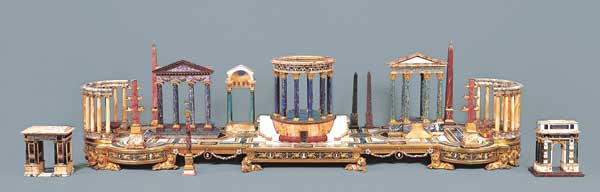
Perhaps I do not know enough about the history of desserts and their presentation in royal courts, but this remarkable piece (also part of the Charles IV exhibition) was, in fact, a dessert service made of gilded bronze, hard stones, ivory, wood, and enamels. As indicated by the name, desserts were arranged with precision on this service, forming an ornate presentation of cakes, pastries, and other edible delights for the King, the Royal family, and their guests-- talk about lavishness and luxuriousness! With or without desserts, this piece is remarkable and, despite my undeniable love of desserts, stands well on its own; the attention to and level of detail on this dessert service (not very noticeable in the image) is mind-blowing. The museum was so fortunate to have such an impressive exhibition, and I know that those who were made the trip in to view it were all but disappointed. My family and I visited the exhibition in its final days, and even though I have been working at the museum the entire summer, the "wow" effect was still there. I was sad to see it go, but now it is time to make way for the upcoming exhibitions for the fall and spring for which I have been researching during my internship!

This is but a fraction of what I could say about my time at the museum this summer. My hours of reading books and typing summaries, walking to and from the library and wandering through the galleries have all shaped my present vision and understanding of Spanish art-- its details and intricacies, historical, religious, and political themes, and overall beauty.  The research I have done as a curatorial intern and the knowledge that the staff has passed on to me are invaluable, and I feel that I have changed not only as a student of art & architectural history but also as a culturally aware human being.

"Only through art can we emerge from ourselves and know what another person sees." -Marcel Proust

Wednesday, July 14, 2010

No. 18, A Philosophical Mission

This evening I found myself at Barnes & Noble, yet again, on a mission: a philosophical mission. While I have always admired philosophy from a safe distance, it was not until recently that I felt the urge to dive into this seemingly dangerous study of the fundamental nature of existence, reality, knowledge, and, of course, life.  Perhaps it is this blog that sparked this interest-- my attempt at seeing the world for its beauty, at appreciating and understanding what makes life, in my opinion, beautiful.

The "Philosophy" section was certainly a modest one; it consisted of two sections of the aisle, strategically--and almost ironically--placed within the "Religion," "New Age," and "Bibles" sections, which are located on the border of the children's area and the "grown-up-books."  It was obvious that the poor Philosophy section had been assigned to that area due to the sheer lack of activity in the area; I did not even know where the Philosophy section was, which should come as a shock to my family and friends who all know of the embarrassing amount of time I have spent in that store.  The aisle must have been overwhelmingly delighted to have a visitor, for the books I planned to purchase tauntingly hid themselves among the almost obnoxious number of copies of Aristotle and Machiavelli anthologies that lined the shelves with the occasional Foucault and Sartre that moaned for attention.  I was somewhat taken aback by titles such as True Blood and Philosophy, Seinfeld and Philosophy, and Mad Men and Philosophy. While I love all of these shows, I couldn't seem to understand their significance, nor could I envision anyone purchasing them for any reason other than a burning desire to add yet another item to their memorabilia.  This was not at all what I imagined when considering philosophical ideas... but then again, perhaps modern philosophy is a great deal more modern than I thought.

Sifting through the works on the shelves for a book by Alain de Botton always proves to be slightly more complicated than I expect; half the time he is listed under "D," the other half under "B," and then the "de" unfailingly causes further problems.  I wonder if this happens only in the United States, probably so. Nevertheless, I eventually found The Consolations of Philosophy, one of the two remaining reads by de Botton I had yet to purchase (the other being Status Anxiety).  Who better to turn to in my discovery and journey through philosophy than a writer I so greatly admire.  Only forty-two pages into the book and I already know it will be as great of a triumph as How Proust Can Change Your Life, which you know, from an earlier entry, has certainly changed my life, igniting a respect and passion for Marcel Proust that has served me well during these difficult weeks since my grandfather's death. De Botton utilizes the teachings of Socrates, Epicurus, Seneca the Younger, Michel de Montaigne, Arthur Schopenhauer, and Friedrich Nietzsche in order to guide the reader through "our most common problems."  Although I am familiar with these philosophers from the literature and history courses I have taken over the years, as a newcomer to philosophy, I have approached this book--as well as this study--with an open mind and the desire to start afresh, prepared to soak in the thoughts that are presented to me.
(Aside from philosophy, however, I truly must recommend any and every book written by the great Alain de Botton. I have now read all of his works with the exception of Status Anxiety and, though I am working on it, The Consolations of Philosophy, and I can honestly say that no one has challenged me--let alone inspired me--to see things from a different perspective quite like Alain de Botton.  De Botton presents his thoughts in such a special, lucid, and intelligent manner, making every book a fantastic and moving experience.)

It was hard to believe that The History of Western Philosophy (originally, A History of Western Philosophy) by Bertrand Russell was so difficult to find. Perhaps it was the summary located on the book's spine that threw me off-- how strange! Though I certainly have the desire to work my way through this immense oeuvre, I hope to have the necessary motivation to complete it after enjoying de Botton's modest and accessible interpretation of philosophy.  This collection of philosophical thought is, in a word, intimidating, totaling in 836 imageless pages. "What exactly is the reason behind his purchase?" one might ask. Well, in discovering the joint program between Paris 1 Panthéon-Sorbonne and Paris 3 La Sorbonne Nouvelle in Philosophy with a track in Lettres Modernes, I found the seemingly perfect opportunity to begin to enrich my comprehension and appreciation of philosophy in the most perfect of settings. I became resolved to participate in this program while still quenching my thirst for art and architectural history courses as well as one or two cinema courses. Why not try something different? How could I possibly resist adding another passion to my life? And even if it does not turn out to be what I expect, there is a lesson to be learned from that experience as well, for, as Proust once said, "We do not receive wisdom; we must discover it for ourselves after a journey that no one can take for us or spare us."

Saturday, July 10, 2010

No. 17, Interlude

I have reached the interlude of my summer.  These past seven (almost eight) weeks have been quite the whirlwind-- or at least in comparison to what I am accustomed to in regards to summer vacation.  Between my summer internship, biology course, "light" reading, blogging, and the untimely death of my grandfather, it is hard to believe that so much has happened in such a fairly short amount of time.  I have a feeling that this next half of the summer might be less... chaotic? Yet I know that the final weeks before my departure for Paris will surely be pandemonium-- packing a year's worth of everything and preparing on an emotional and mental level.

It's hard to imagine what life will be like seven weeks and two days from now-- the day I exchange Dallas, Texas for Paris, France.  I would be fooling myself if I planned on it being completely different. I'll wake up and most likely feel as if I am embarking on any ordinary trip, gather my last minute items (contacts, glasses, toothbrush, laptop, and, impulsively, a book I probably will never end up reading).  I'll load my bags into the car and hop in myself, anticipating the numerous times my mother will turn to ask me, "are you sure you have your passport? Your plane ticket? Everything?" I'll answer "yes," slightly more irritated each time, and as DFW-Airport comes into sight, a gaping hole will produce itself in the pit of my stomach, and I will immediately regret my decision-- a side-effect of overexcitement trying to trick me out of my dream. Before exiting the car, I will take a deep breath, observe the meaningless parking lot and then the driver's seat where my mom will be seated about to ask me, "you ready?" or "are you going to be okay?" Or both. I will then start to cry, if I hadn't already, and as I unload my bags and approach the security line, my mom and I will reassure me that everything will be fine, that I am ready, that I never wanted anything more than I want this.  And then I will go.

Only time will tell if I have envisioned this spot-on. Imagining my life in a different setting--both physical and mental--is almost impossible for me. I think of only the more "glamorous" moments rather than taking a more realistic approach. I know very well that this experience will throw some curved balls at me, but I also know that I am not alone in the desire to ignore this fact, this undeniable truth.  I will miss my home, my family and friends, and, probably most of all, I will miss my sister.  Yes, my sister is family, of course, but she is really something so much more. Though only four and a half years apart, I often joke that we were meant to be twins, only she wasn't quite ready yet.  I like to think that she knows how important she is to me, but perhaps she does not. So incase you ever second-guess it, Mowmao, you are my true best friend.

Why am I reflecting now, so far in advance?  Probably because this has been my first chance since arriving home from school that I have had the chance to think without the pressure of other things needing to be done, needing my attention. I think of Paris, France, and Europe every single day, yet I have failed to consider all that I will leave behind thoroughly.

Who will I be a year from now? Six months from now? Two months from now? That person is in the making and is only to be bettered, more colorful, more passionate, more reflective.  New experiences bring on new facets, new features for one's personality and character, and oftentimes, these details are visible to others and, especially, to oneself. If there is one thing I anticipate most about this experience, it is not the guaranteed improvement of my French, nor is it the classes I will take, the friends I will make, or the new places I will visit.  It is the way in which, as a result of all of these minor ingredients in my journey, I will see the world-- the way I will embrace life through my more developed and more seasoned eyes.  For as my beloved Marcel Proust said, "The real voyage of discovery consists not in seeking new landscapes, but in having new eyes."

Sunday, July 4, 2010

No. 16, Proust Questionnaire


Several times in his life, Marcel Proust responded to an English-language questionnaire (now called the Proust Questionnaire), of which the answers were compiled into manuscripts.

 Proust's responses were just as personal and intimate as they were meaningful.  Whether or not he aimed to be profound or merely honest, I do not know.  I assume that he had no intention of publishing the questionnaires, for Proust was not one to be arrogant, conceded, or self-absorbed.  Whatever the circumstances, I find the questionnaire to be a valuable peek into Proust's mind, which was as playful as it was straightforward.

One question asks for one's favorite occupation, to which Proust responded, "Loving."  Another demanded one's idea of misery-- "Not to have known my mother or my grandmother."  Favorite Bird: "the Swallow." Hero in fiction: "Hamlet."  A favorite of mine is his answer to "the natural talent I would like to have: "will-power and irresistible charm."  Perhaps it is because I view and adore Proust for the profundity of his thoughts and written word that I find this response so surprisingly unlike Proust; yet that does not make me love it any less-- quite the contrary, in fact.

However, there are two responses that I most greatly admire, both of which has become very important to me since I first heard of and read the questionnaire:

1. The country where I should like to live: "One where certain things that I want would be realized, and where tenderness would always be reciprocated."
 2. How I wish to die: "A better man that I am, and much beloved."

Yes, I love France a seemingly impossible amount.  And yes, I plan to live there this year and, most likely, at least another year if I am accepted for the assistantship program upon graduating from university. Do I want to live there for the rest of my life?  That I do not know.  While tenderness may not always be reciprocated--for that seems too perfect to be true--France is, for me, a country that is magical, where any dream seems attainable; there is some sort of mysterious power that takes over me when I see Notre-Dame de Paris, a terraced café, or just a mere librairie.  It is dazzling, mystifying, and vivifying, much like a fairy tale.  I know that life is not perfect and that life in France will not attain perfection, but the journey toward this "ideal life" is best traveled with an open mind and open heart and by approaching each day and each experience with the same amount of wonder and excitement as the last.  To realize anything that I desire. To keep the magic alive.

Just one week ago today, I was at my grandfather's funeral.  I have yet to fully accept the reality of his death.  His health had been poor and further deteriorating the last years of his life, and an injury he suffered during the Holocaust served as a constant reminder of the pain he would have to endure--both physically and mentally--throughout his life.  Even still, he provided the best life possible for his wife, his three children, and his six grandchildren while also giving back to the community and building a multitude of business relationships and friendships.  He improved his quality of life through his motivation, dedication, and sheer desire to live upon arriving in the United States in 1948.  Through his successes and his family, he improved both his image to others and his spirit within himself, which was surely a hard task after experiencing the atrocities he faced as a young man.  To say that he died loved would be an understatement to the greatest degree.  At his funeral, there was hardly any remaining standing room; the chapel was filled to capacity with people who loved, admired, and cherished my grandfather-- young and old, family and friends, acquaintances and life-long companions.  I think Proust might have admired my grandfather, but in any case, I certainly do.  Like Proust and after reflecting on the life of my grandfather, I, too, hope to die improved and loved, or even just loved, for nothing could be more important than feeling valued and cherished by others, especially those that I myself value and cherish.  But aside from death, I want to live loved for a long, long time.

Perhaps it was simply Proust's boredom that inspired him to respond to the questionnaire at certain intervals in his life.  Yet I would like to believe that he answered the questions with the intentions of "monitoring" his personal growth-- the ways in which his views would change at various points in his life-- and, furthermore, as a way to reflect on what motivated these transformations.  I believe that it is important to take a step back from time to time and view ourselves from a different angle, a varied perspective; it might inspire oneself to travel in a different direction, to change our ways, or even confirm the accuracy of the path one is currently taking.

The first item on the questionnaire asks for one's "most marked characteristic."  While Proust's response is surely personal, I feel his reply is not only honest and sincere but also the response we would all give if we were not quite as ashamed or embarrassed to admit its truth, for we all have: "A craving to be loved, or, to be more precise, to be caressed and spoiled rather than to be admired."