Five weeks and three days until Paris-- this is becoming more and more real. Despite a minor error with my visa dates, I received my corrected
Visa de Long Séjour in the mail yesterday, allowing me an eleven-month stay in France. Airline reservations have been made, and I officially have an apartment in Paris that will be ready for me upon my arrival (
grâce à Mme Flam-merci!) While there is certainly a long, intimidating list of
choses à faire (bank account, electricity, cell phone, internet, etc), I cannot help but be overwhelmingly excited that my dream is coming true so smoothly-- at least thus far. All I need to do is pack, and I'll be good to go!
Next Friday is the last day of my internship at the art museum I have been working at this summer. I cannot begin to believe how quickly the past seven weeks have gone. I have learned so much, written even more, and have come to love and appreciate Spanish art. Working in a museum, I have such a great deal of respect for my boss and the rest of the staff; they are like animated encyclopedias and seem to know almost everything there is to know about not only the art in the collection but also any potential additions and Spanish art in general. The painting above, painted by Joaquín Sorolla y Bastida, is titled
El ciego de Toledo (
The Blind Man of Toledo, 1906). It should come as no surprise that Sorolla was an Impressionist painter-- oh, how I love the Impressionists! The textures of this painting are quite remarkable, and the combination of portrait, landscape, and architecture seems almost flawless. While I thoroughly enjoy viewing the incredible paintings by Francisco José de Goya y Lucientes, Diego Rodríguez de Silva y Velázquez, and Bartolomé Esteban Murillo, the collection offers the works of many Spanish (and some non-Spanish) artists like Sorolla who are both intriguing and inspiring.
The museum's most recent exhibition (which closed this past Sunday) was titled:
Royal Splendor in the Enlightenment: Charles IV of Spain, Collector and Patron. As the exhibition title explains, the collection of works consisted of artwork that was collected by King Charles IV of Spain (1748-1819) as well as art that was designed for him during his reign. This exhibition consisted of paintings, tapestries, sculptures, vases, clocks, the Sedan chair of Queen María Luisa of Parma (absolutely stunning), and so forth. One of my favorite pieces of this collection was this bird cage clock, designed with gilded bronze, enamels, and porcelain. Although it is not visible in this image, the bottom of the birdcage was a porcelain clock, which could be seen when the bird cage was hung from the ceiling. I have never before seen a piece quite like this; it is an innovative and beautiful way of simultaneously displaying the time as well as wealth.
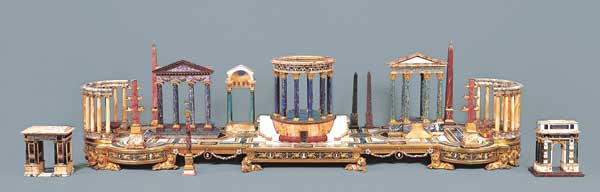
Perhaps I do not know enough about the history of desserts and their presentation in royal courts, but this remarkable piece (also part of the Charles IV exhibition) was, in fact, a dessert service made of gilded bronze, hard stones, ivory, wood, and enamels. As indicated by the name, desserts were arranged with precision on this service, forming an ornate presentation of cakes, pastries, and other edible delights for the King, the Royal family, and their guests-- talk about lavishness and luxuriousness! With or without desserts, this piece is remarkable and, despite my undeniable love of desserts, stands well on its own; the attention to and level of detail on this dessert service (not very noticeable in the image) is mind-blowing. The museum was so fortunate to have such an impressive exhibition, and I know that those who were made the trip in to view it were all but disappointed. My family and I visited the exhibition in its final days, and even though I have been working at the museum the entire summer, the "wow" effect was still there. I was sad to see it go, but now it is time to make way for the upcoming exhibitions for the fall and spring for which I have been researching during my internship!
This is but a fraction of what I could say about my time at the museum this summer. My hours of reading books and typing summaries, walking to and from the library and wandering through the galleries have all shaped my present vision and understanding of Spanish art-- its details and intricacies, historical, religious, and political themes, and overall beauty. The research I have done as a curatorial intern and the knowledge that the staff has passed on to me are invaluable, and I feel that I have changed not only as a student of art & architectural history but also as a culturally aware human being.
"
Only through art can we emerge from ourselves and know what another person sees." -Marcel Proust


No comments:
Post a Comment