
Alain de Botton's first non-fiction work is titled How Proust Can Change Your Life. This book has been on my reading list even since I completed The Architecture of Happiness, yet it had remained overlooked until this past Thursday evening when I found myself at Barnes & Noble while browsing the "Essays" section. Just two shelves above literary luminary, David Sedaris, I saw the all-too familiar cover of The Architecture of Happiness beside How Proust Can Change Your Life, a funny-looking paperback with green- and orange-tiled images of Marcel Proust, a renowned French novelist and essayist. This welcomed confrontation forced me into purchased the book, which I eagerly began upon returning home.
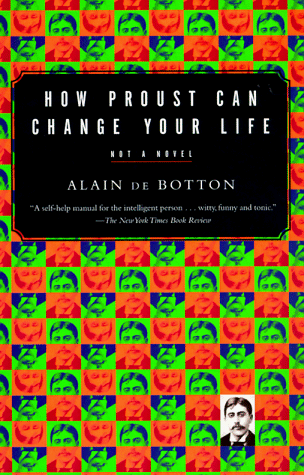
Marcel Proust (or, Valentin Louis Georges Eugène Marcel Proust) is best known for his seven-part semi-biographical oeuvre À la recherche du temps perdu (In Search of Lost Time), which totals in 3,200 pages-- of which I have only read several excerpts. This project began in 1909 and ended with Proust's death at the age of fifty-one in 1922. Proust is described as a man who lived for detail, valuing the minutia to be equal, if not more precious, than the "plot-summary" points. In the chapter of How Proust Can Change Your Life that is appropriately titled "How to Take Your Time," de Botton discusses Proust's conflict with reading the newspaper-- more specifically, the "news-in-brief" section-- for he felt that condensing a story to such a great degree undermined and damaged its events and their importance, compelling Proust to imagine the "bigger picture" for himself--however accurate or faulty it would be. De Botton writes, "it shows how vulnerable much of human experience is to abbreviation, how easily it can be stripped of the more obvious signposts by which we guide ourselves when ascribing importance." I find this so profound-- probably because it is true.
Clearly the length of Proust's works boldly represent the extreme opposite on this spectrum of detail, a quality that both deterred (and still deters) readers as well as induced praise from critics who cited Proust as a "literary genius." While I myself have not braved the immensity of À la recherche du temps perdu, I hope to do so one day. Nevertheless, I do value Proust's strive to spotlight and emphasize the significance of small details and trivialities, from the annoyance of restlessness to the particularities of one's morning routine. After all, these aspects shape us-- our identities. Although whether we comb our hair before brushing our teeth (or vice versa) may not share any insight on our value as human beings, it certainly reveals how one person is different from the next in an infinite number of ways. These minor distinctions and variations remind us of how beautiful we are in our own respective ways and should, hopefully, make us step back and recognize the grace and wonder we can find in one another.
De Botton, Alain. How Proust Can Change Your Life. New York: Vintage International, 1997.


Thanks for the tribute
ReplyDelete-in memory of this night spent at the Harvard COOP, wandering in the isles between the "life statement" books, the Tashens, the cooking books, the books about impressionism, about French culture, about Paris, about modern architectural design; the books by David Sedaris, those by some French-haters (don't worry, only to feed winter fires... even though, right, there may not be many fires to feed in Dalla... ohh well! ), those about yoga (NO KIDDING-CHILD POSE+"DOWNERRR DOGGGG"=ABSOLUTELY CRUTIAL; thanks D.)
So, now, THE "Proustian" question: what is your madeleine?!
Thank you to my biggest, most devoted fan / reader!!
ReplyDeleteMy madeleine: Jamoca ice cream from Baskin Robbins. The best of the best, sans doute!