Sunday, May 30, 2010

No. 9, La Richesse du Monde: Film

Film, like art, is yet another way to capture the emotion and imagination of the screenwriter, director, actors, and all who are involved in the creation of the project.  I find it immensely important not only to my life on a personal level but also to la richesse du monde, for it manifests the progress, creativity, and determination of humankind.  The final product acts as a direct contribution to society with the additional desire to entertain, educate, and/or enchant its viewers.

My love for film is one of the constants in my life.  About four years ago, I began collecting French films and have been slowly adding to my collection ever since.  I adore The Criterion Collection despite the high prices, for the bonus features are generous and often include conversations with the director, actors, storyboards, etc.  Film has the unique ability to have a profound influence on one's views of life and the world as well as conjure up feelings of nostalgia, happiness, and sadness with little effort.  These are the ways by which consider my favorite films-- their meaning(s) and their effect(s).  In building a list of my favorite films, I originally aimed for five, which turned into ten, which ultimately turned into fifteen.  I could easily continue on to thirty or perhaps fifty, but I feel that these fifteen effectively capture the value of film in my life.  However, I will only elaborate on my top five for the sake of the reader, especially considering the endless amount of praise I can give for each of these phenomenal films.


1. The English Patient (1996)


It is with no hesitation that I rank "The English Patient" as my all-time favorite film.  While it is neither a revolutionary film in the history of cinema nor ranked on the AFI Top 100 Film list, "The English Patient" is the most poignant, romantic, and epic film I have ever seen-- and, most likely, will ever see.  The story begins with a man who, while flying a plane in the Egyptian desert, is shot down by Nazis and, consequently, critically burned. Initially known as "the English patient," the man is under the care of Hana (Juliette Binoche) in an abandoned monastery in Italy just before the surrender of the Germans in World War II.  Over the course of the film, the man experiences a series of flashbacks of his life before the accident, gradually shedding light on his identity, which he himself can no longer recall.  The viewer learns the patient is Count László de Almásy (Ralph Fiennes), and the flashbacks illustrate his passionate affair with Katharine Clifton (Kristin Scott Thomas).  The film also follows the nurse, Hana, and her relationship with Kip (Naveen Andrews), an Indian sapper who defuses bombs for the British Army.  "The English Patient" also features Willem Dafoe as David Carvaggio, whose fate depended on the actions of Almásy, as well as Colin Firth as Geoffrey Clifton, Katharine's husband.  Based on the novel by Michael Ondaatje, director Anthony Mingella's visually stunning interpretation of "The English Patient" went on to win nine Academy Awards, including Best Picture.  The score, written by Gabriel Yared, is flawless; the movie theme serves as an immediate reminder of the depth and passion of the film as depicted by the cast.  I admit that Ralph Fiennes, Kristin Scott Thomas, and Juliette Binoche made it on to my short list of favorite actors and actresses solely based on this film--though each of them have immensely impressive filmographies, i.e. "Schindler's List" (Fiennes), "Il y a longtemps que je t'aime" (Thomas), and "Les Amants du Pont-Neuf" (Binoche).
I remember being floored by the cinematography and the screenplay (which I own).  Every scene is lit perfectly, making the desert and a run-down monastery appear divine and surreal; every line is so intense and sincere.  At the end of the film, Hana reads a message that Katharine had written to Almásy, which happens to be one of my favorite quotes from the movie:


Katharine: "My darling, I'm waiting for you. How long is a day in the dark? Or a week? The fire is gone now, and I'm horribly cold. I really ought to drag myself outside-- but then there would be the sun. I'm afraid I waste the light on the paintings and o writing these words. We die, we die rich with lovers and tribes, tastes we have swallowed, bodies we've entered and swum up like rivers, fears we've hidden in like this wretched cave. I want all this marked on my body. We are the real countries are, not boundaries drawn on maps with the names of powerful men. I know you will come carry me out to the palace of winds. That's what I've wanted-- to walk in such a place with you, with friends, on an earth without maps. The lamp has gone out, and I'm writing in the darkness."

2. Rushmore (1998)
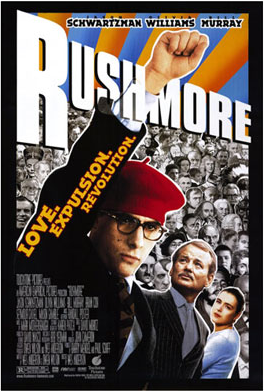

Wes Anderson's second feature-length film, "Rushmore," easily ranks second on my list.  Of course I admire all Wes Anderson projects-- all the way from "Bottle Rocket" (1996) to "Fantastic Mr. Fox" (2009)-- but "Rushmore" never fails to make me cry yet feel genuinely happy in the end.
The Film centers on Max Fischer, an eccentric fifteen year-old, and his relationships with Herman Blume (Bill Murray), a snobby, rich industrialist, and Rosemary Cross (Olivia Williams), an elementary school teacher at Rushmore Academy (where Max is a student) with whom both Max and Herman are in love.  Max finds greater success in extracurricular activities than academics, yet he is completely devoted to Rushmore.  He becomes close friends with Herman Blume, finding him inspiring, as well as becomes infatuated with Ms. Cross and proceeds to make attempts at impressing her and attracting her attention in any way.  However, due to one of his plans, Max is ultimately expelled from Rushmore, forcing him to attend public school.  Without giving the story away, the film continues to follow Max, spotlighting the way he adapts to his new school and the realizations he makes about Herman Blume, Rosemary Cross, life, and, most importantly, himself while fostering his talent as a playwright.
Everything about this film is ideal-- the casting, the screenwriting, the soundtrack, etc.  This is one of my top "go-to" films after having a bad day; the story and characters are so real, and the film succeeds in engaging the viewer without being overwhelmingly dramatic or comical--though "Rushmore" is most definitely hysterical, but in a "down-to-earth" sort of way.  Much like I felt after watching "The English Patient" for the first time, after viewing "Rushmore," I knew that it would be a film that I kept by my side for the rest of my life.  I always recommend it to friends, for it is only 93 minutes and is, I believe, a film that anyone can appreciate if given the chance.
The soundtrack is certainly one of the movie's strongest points; Mark Mothersbaugh is a musical genius, and each of the songs selected for every Anderson film soundtrack, especially "Rushmore," is perfect.  The scene in which Max plays Yves Montand's "Rue St. Vincent" in an attempt to almost-seduce his teacher is simultaneously comical and poignant, and the final song before the credits, "Ooh La La" (The Faces), always makes me smile, for it plays during the final scene of the film where all conflicts are resolved and all of the characters experience a moment of collective contentment.
While I feel that Wes Anderson and Jason Schwartzman should have their separate identities, the two really do go together (for me) because of this movie, as well as the fact that it launched Schwartzman's career.  While Schwartzman has not been involved in all of Anderson's projects, I believe that my connection with Wes Anderson's films can be attributed to the recurring collaborators: Angelica Huston, Bill Murray, Mark Mothersbaugh, Luke Wilson, Owen Wilson, Kuman Pallana, and so forth.  This creates a feeling of familiarity that builds a relationship with the viewer, making one feel like part of "the family."
When "The Darjeeling Limited" (2007) was released in Dallas (along with the short into film, "Hotel Chevalier"), I attended the premiere and Q&A session for the film, which Jason Schwartzman attended.  Schwartzman contributed as a writer (as well as an actor) along with Anderson and Roman Coppola, Schwartzman's cousin.  Schwartzman discussed the experience of filming the feature on an actual moving train as well as shared some insight on the writing process.  "The Darjeeling Limited" features an exquisite soundtrack and brilliant cast--like all Anderson films.  But the film demonstrates the profound effect of color through clothing, landscapes, and people, making the film far more visually striking than all preceding Wes Anderson projects.  Yet I maintain that Wes Anderson has an unparalleled talent in writing and directing, which is responsible for his large and dedicated following of which I am proud to be a part.

3. Le Fabuleux Destin d'Amélie Poulain (2001)


As a French major and French film enthusiast, "Le Fabuleux Destin d'Amélie Poulain" (better known as "Amélie") is a relatively unoriginal pick for a favorite film, but, honestly, who can deny its geniusness?  Jean-Pierre Jeunet is a mastermind of writing and directing, creating heartfelt stories and happy endings amid the bizarre and surreal events that accelerate the film.  Like Wes Anderson, Jeunet has recurring collaborators, making a team composed of fantastic actors and cinematographers (i.e. Dominique Pinon, Rufus & Ticky Holgado, Jean-Claude Dreyfus, Darius Khondki, and Bruno Delbonnel) as well as a brilliant editor, Hervé Schneid, and set designer, Aline Bonetto.  Most American moviegoers would recognize Audrey Tautou for her role as Sophie Neveu in "The Da Vinci Code" or, if they ventured to independent theaters, "Coco Avant Chanel" in which she played the title role, Coco Chanel.  After winning the César Award for "Most Promising Actress for her role in "Vénus beauté (institut)" in 1999, Tautou was casted for the title role of Jeunet's "Amélie," which was released in 2001.
"Amélie" follows a shy waitress in the district of Monmartre in Paris as she performs little acts of kindness to change and improve the lives of others while also figuring out her own life.  Amélie was mistakenly diagnosed with a heart defect as a child, forcing her parents to home-school her and, thus, separate her from other children, isolating her from the world.  At the age of six, Amélie's mother dies in a freak accident, after which her father dedicates his life to creating a memorial in their garden for his late wife.  Even more alone than before, Amélie confronts her solitude with her active imagination.  The story fast-forwards, and we find Amélie as a young woman who has experienced several failed romantic relationships and, as a response, immerses herself in life's simple pleasures.  One evening, Amélie finds a metal box behind a bathroom tile and becomes resolved to return it to its rightful owner.  Amélie meets several characters along the way, including Raymond Dufayel, a painter with a brittle bone condition, who assists Amélie in tracking down Dominique Bretodeau, the owner of the box.  After successfully, yet anonymously, returning the box, Amélie is inspired to continue with these deeds of kindness, for she finds happiness in her actions.  The film continues to follow Amélie on her journey of personal growth as she not only makes other people happy but also finds love for herself.
The film is a treasure and truly sincere; it is unique--to say the least--and makes even the most mundane details of the everyday seem magical and captivating, which, I believe, makes "Amélie" so special.  It is a "feel-good" film on a completely different level than all others.  Rather than feeling uncomfortable and disoriented by the surreal style of filming and the eccentric visual effects, "Amélie" invites and embraces the viewer, bridging an intimate connection between Amélie's and the viewer's subsequent self-contentment.
Other Jeunet films that I adore are: "La Cité des enfants perdus" (1995) and "Un long dimanche de fiançailles" (2004).  "La Cité des enfants perdus" is a dark, fantasy film while "Un long dimanche de fiançailles" tells the romantic tale of a woman (Audrey Tautou) in search of her lover who went missing during World War I.  Although "Un long dimanche de fiançailles" is more morbid and heart wrenching than Jeunet's other films, it still captures the same determination and passion for which Jeunet is known.  Jeunet recently released the film "Micmacs," which has been well received and enjoyed by moviegoers and critics alike, and is certainly on my must-see list for the summer.

4. 2 Days in Paris (2007)


"2 Days in Paris" is a Julie Delpy project in every sense; Delpy is the director, producer, writer, narrator, star, editor, and composer of the film.  Though it was not Delpy's directorial debut, "2 Days in Paris" achieved a fair amount of success in the United States in comparison to her earlier projects ("Blah Blah Blah" (1995) and "Looking for Jimmy" (2002)).  The daughter of notable French actors Marie Pillet and Albert Delpy, Julie Delpy is best known in the United States for her role alongside Ethan Hawke in "Before Sunrise" (1995) and its sequel, "Before Sunset" (2004), for which Delpy co-wrote the screenplay.  I adore both "Before Sunrise" and "Before Sunset," but I must say that one must have a good deal of patience, for each of these films consist of a single conversation that lasts from beginning to end with limited or little "action"-- for lack of a better term.  Some find the films boring; I, on the other hand, see them as chances to truly get to know the two characters, a limited opportunity in film.  By the end of the movies, you know the characters inside and out-- their hopes, dreams, heartbreaks, quirks, and so forth.  In "2 Days in Paris," the opportunity for such a bond between viewer and character arises once again, yet Delpy adds the welcomed element of comedy with the help of co-star Adam Goldberg.
Julie Delpy's character, Marion, narrates "2 Days in Paris," a story about Marion, a French photographer, who is returning from a romantic trip to Venice with her American boyfriend, Jack (Goldberg), and plans to spend two days in Paris with Jack before heading back to New York.  Marion is assertive yet insecure while Jack is neurotic, a hypochondriac, and, as it turns out, insecure as well.  In addition to the conflicts that arise from cultural differences and clashes, the couple is constantly running into Marion's ex-boyfriends and -lovers with whom, to Jack's surprise, Marion is still friendly and is in contact.  The film follows these encounters and the way in which they impact Jack and Marion's relationship, which has its ups and downs throughout the movie.
While implementing humor to "spice up" the story, "2 Days in Paris" remains a deep and thoughtful examination of modern relationships and love, keeping the film as real and "down-to-earth" as possible, which, I feel, is the reason for its success.  Delpy and Goldberg are a fun and very attractive pair, which could be attributed to their past romance as well as the fact that they are both phenomenal actors--and, in my opinion, under appreciated and overlooked in cinema.  On another personal note, I really love the sound of Julie Delpy's voice; it is so distinctive, sincere, and reflective, and she narrates the film as if relating the story to a close friend, making me feel like I know her on a personal level rather than merely admiring her from the comforts of my couch.  In 2009, Delpy released another film that she wrote, directed, produced, composed, etc, "The Countess," which tells the story of Erzebet Báthory, a powerful and fearsome Hungarian countess.  Countess Báthory falls in love with a younger man whose father does not approve of their relationship and leads the Countess to believe that his son no longer loves her.  This heartbreak forces the Countess on a murderous rampage, taking revenge on the beauty of the youth and believing that the blood of virgins will preserve her beauty.  It is a dark and heartbreaking story that is beautifully interpreted and manifested by Julie Delpy, who portrays the Countess.  Delpy shows the versatility of not only her filming and writing technique but also her talents as an actress.
Adam Goldberg is also one of my favorite actors.  Best known for his role in "Dazed and Confused" (1993), "Saving Private Ryan" (1998), and "How to Lose a Guy in 10 Days" (2003), Adam Goldberg, like Delpy, is also a director, producer, actor, and musician.  His current music group, "LANDy," is an interesting and entertaining project, and their debut album "Eros and Omissions" was released this past year ("BFF!" is a fantastic song).
Returning to "2 Days in Paris," I would like to bring this commentary to a close with the closing monologue of the film, which is quite poignant and well written.  It will certainly be best appreciated after viewing the film, but these words give a potential viewer a good idea of the depth this film reaches.


Marion: "It always fascinated me how people go from loving you madly to nothing at all, nothing. It hurts so much. When I feel someone is going to leave me, I have a tendency to break up first before I hear the whole thing. Here it is. One more, one less. Another wasted love story. I really love this one. When I think that it's over, that I'll never see him again like this... well yes, I'll bump into him, we'll meet our new boyfriend and girlfriend, act as if we had never been together, then we'll slowly think of each other less and less until we forget each other completely. Almost. Always the same for me. Break up, break down. Drink up, fool around. Meet one guy, then another, f*** around. Forget the one and only. Then after a few months of total emptiness, start again to look for true love, desperately look everywhere and after two years of loneliness, meet a new love and swear it is the one until that one is gone as well. There's a moment in life where you can't recover anymore from another break-up. And even if this person bugs you sixty percent of the time, well, you still can't live without him. And even if he wakes you up every day by sneezing right into your face, well, you love his sneezes more than anyone else's kisses."


5. Moulin Rouge! (2001)
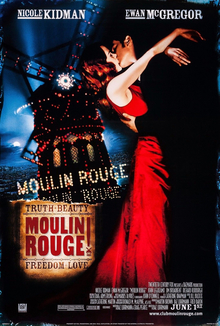

"Moulin Rouge!" is the final film in Baz Luhrmann's "Red Curtain Triology," which began with "Strictly Ballroom" (1992) and was followed by "William Shakespeare's Romeo + Juliet" (1996).  Luhrmann's method of filming and storytelling are quite revolutionary, providing a clear theme in each of the films in the trilogy: dancing ("Strictly Ballroom"), poetry ("Romeo + Juliet"), and music ("Moulin Rouge!").  Heavily influenced by Italian opera and Bollywood cinema, Luhrmann developed his signature style, which included swirling camera motion, wild cutting, and extreme close-ups.
"Moulin Rouge!" is inspired by Guiseppe Verdi's opera "La Traviata" (coincidentally my favorite opera even before the release of "Moulin Rouge!") and tells the story of Christian (Ewan McGregor), an English poet and writer, who arrives in Paris in 1899, settles in the quarter of Montmartre, and pursues his writing career.  He falls in love with Satine, an actress and courtesan at the Moulin Rouge, who ultimately dies, as we learn at the very beginning of the film.  "Moulin Rouge!" follows the story of their passionate love and the transformation of the Moulin Rouge into a theater, made possible by the financial investment of the Duke (Richard Roxburgh), the villain of the story.  Infused with well-known popular music, "Moulin Rouge!" is a move-musical that stands apart from all the rest.  With song like Elton John's "Your Song," The Police's "Roxanne," and Queen's "The Show Must Go On," it is impossible to keep from singing, especially upon hearing the beautiful interpretations of these classics.  "Elephant Love Medley" is the first song shared between Christian and Satine and is both catchy and heartfelt; it is comprised of songs like "All You Need is Love" (The Beatles), "Pride (In the Name of Love)" (U2), "Don't Leave Me This Way" (Harold Melvin & the Blue Notes), "Silly Love Songs" (Paul McCartney and Wings), and "Heroes" (David Bowie), to name a few. "Come What May" is known as the lovers' "secret song" in the film and is the movie's only original song, which went on to receive a Golden Globe nomination and is included on the AFI's 100 Year, 100 Songs list.  It is an intense and emotional ballad that is sung twice in the film.  However, the soundtrack, which consists of two volumes, is fantastic in general--a must buy for any music lover.
How do I begin to explain what "Moulin Rouge!" means to me?  I was eleven when the film was released, and my mother, thinking I was too young decided it would be best to refrain from seeing it in theaters-- much to my dismay.  However, soon after "Moulin Rouge!" was released on video, my mother, younger sister, and I watched the film and were left speechless-- jaws dropped, tears flooding down our faces, and hearts racing.  Until this day, we still speak about the film as if it were a life-changing experience, which it truly was.  My sister and I were immediately obsessed; I bought the sheet music and [poorly] sang all of the songs, and my sister would type up the script word for word on a typewriter that we bought shortly after being inspired by Christian's character in the film.  For my sister's ninth birthday party, the house was decorated with screen-caps from the movie, and all of the girls were encouraged to dress up like the Moulin Rouge dancers-- certainly a nightmare to any parent other than my mother and father.  Most of my friends from middle school and the majority of my high school-friends know me for my love for "Moulin Rouge!," and I am proud to be responsible for their conversions into part of the cult.  In seventh grade, a few years after my love affair had begun, my class took a trip to New York City, and one of my fondest memories from the trip was walking through the city at night, arm-in-arm with my friend, Aviva, singing "Your Song," "Elephant Love Medley," and "Come What May" at the top of our lungs without a care in the world.  My best friend Laura and I also share a love for "Moulin Rouge!," and we never hesitate to text one another when we are reminded of the film or are watching it, which I often am.  My sister and I can still recite the film from start to finish, including its songs, and every time I watch "Moulin Rouge!," it brings me back to the first time all over again, and I never cry any less than the time before.
Nicole Kidman won the Golden Globe for "Best Actress" and is stunning both as an actress and as a singer, which she had never attempted at before starring in "Moulin Rouge!"  Ewan McGregor is irresistable with an equally remarkable voice and his overwhelming sincerity.  In addition to Kidman and McGregor, the casting choices as a whole could not have been better; Jim Broadbent ("Iris," "Bridget Jones' Diary") plays Harold Zidler, the owner of the Moulin Rouge, and John Leguizamo ("Carlito's Way," "Romeo + Juliet") takes the role of Henri de Toulouse-Lautrec.
One can see the phenomenal imagination of Baz Luhrmann at work throughout the film, fashioning a masterpiece of cinema, dance, and music that captures the hearts of viewers of any age, forming an intimate bond that is sure to last a lifetime.

"The greatest thing you'll ever learn is just to love and be loved in return."


6. West Side Story (1961)
7. Les Chansons d'Amour (2007)
8. Rear Window (1954)
9. Jeux d'Enfants (2003)
10. Basic Instinct (1992)
11. Annie Hall (1977)
12. The Way We Were (1973) 
13. Les Parapluies de Cherbourg (1964)
14. Bridget Jones' Diary (2001)
15. The Sound of Music (1965)

Wednesday, May 26, 2010

No. 8, La Richesse du Monde: Art

Art is a state of being, a mode of expression, and a key element of la richesse du monde.  Of course, the way in which one defines art is a personal interpretation, but I defend the idea that it exists anywhere and everywhere-- from the way the sun serves as a spotlight and reflects off buildings to a floral arrangement that controls the ambience of a dining room; from a Renoir or Rembrandt to a Cézanne or Courbet.

Next week, I will be beginning my summer internship at the art museum of a local university.  I am greatly looking forward to this experience and all that I will learn.  I woke up this morning thinking about art, more specifically, the paintings that have most profoundly affected me during my life thus far.  I was surprised to discover that not one of my "top five paintings" had ever been explored in any of my art history courses.  While the painters themselves have had several classes dedicated to their works, I discovered my favorites either on my own or by the recommendations of others.

5. Pierre-August Renoir- Doge's Palace, Venice (1881)
Clark Art Institute, Williamstown, Massachusetts


This painting is quite stunning.  While I adore the realms of art and art history, I have to admit that my passion runs even deeper for architectural history.  When analyzing the gothic palace through the lens of architecture, the Palazzo Ducale di Venezia is a remarkable example of a structure that clearly expresses its meaning and value through its design.  As the residence of the Doge of Venice, the palace is of great importance, which is evident through the tower that rises well above the surrounding buildings.   Located in Piazza San Marco, the principal square of Venice and a great attraction to visitors, the presence of the Doge's Palace is undeniable; the arcaded windows echo the waves of the Laguna di Venezia, a key element of Venice's maritime empire, which continues to serve as a base for a seaport.
In this painting, Renoir captures the majestic wonder of the Palazzo Ducale-- its setting, design, and significance.  Many know Renoir for paintings such as Bal du moulin de la Galette (1876), Le Déjeuner (1880-1881), and, more generally, the way in which he captures the emotions of the people spotlighted in his works.  Yet I feel that his illustration of Doge's Palace is refreshing; aside from the absence of humans, Renoir asserts that architecture can stand alone as the subject of a painting.  And he is right, for architecture is the reflection of not only the people that design the buildings but also those who live within the built environment of their villages, towns, and cities.

4. Claude Monet- La Série des Cathédrales de Rouen (1892-1893)
[found in various museums around the world, including Musée d'Orsay in Paris, France, National Gallery of Art in Washington D.C., and Pola Museum of Art in Hakone, Japan]


Cathédrale Notre-Dame de Rouen is a mesmerizing site and, apparently, Claude Monet agreed.  The construction of the cathedral lasted from 1202-1880 and held the reign of tallest building from 1876-1888, yet it suffered damage from two bombings in World War II.  In this project of more than thirty paintings, Monet pursued his interest in light, capturing the façade of the cathedral at various times of the day in order to illustrate the way in which light provides discrete perspectives.  Monet, like Renoir, proves to the spectator that architecture can play the main role in a painting as well as the existence of the "in-betweens" that link "night" and "day."
I have a weakness for gothic cathedrals, and Rouen Cathedral is no exception.  This collection is breathtaking and clearly exposes the architectural grandeur of the cathedral at all points of the day.  Even though Monet is better known for Le Déjeuner sur l'herbe (1865-1866) and Les Nymphéas (1920-1926), I believe that the Rouen Cathedral series equally demonstrates his artistic prowess and magnificence.

3. Claude Monet- Les Nymphéas (1914-1926)
[specifically, the eight pieces at Musée de l'Orangerie in Paris, France]


However, I must say that Monet's Les Nymphéas are gorgeous.  A series of 250 oil paintings, les Nymphéas depict the flowers and sites of Monet's flower garden at Giverny, again a varying times of the day.  While the paintings are scattered throughout the world, eight of the paintings are spotlighted at the Musée de l'Orangerie in Paris.  On the lower level of the museum, after passing through the vestibule space, there is a series of two salles dedicated to the display of these paintings.  The paintings-- the largest of which measures 200 by 1700 cm (Les Deux Saules)-- embrace the viewer by hugging the shape of the room much like pronounced wall paper.  Each of the works are visually stunning in their own respective manners, creating an experience inundated with tranquility and awe through the color palette and scale of the paintings.
I clearly remember my first visit to the Musée de l'Orangerie during my first visit to Paris after completing a language immersion program in Nice.  One of my friends from high school, Annie, was studying in Paris at the time, and we arranged to meet up at the museum, which had been closed from August 1999 until May 2006 and, thus, had recently reopened to the public with a new design and the special addition of the Nymphéas exhibit.  To celebrate the reopening, more than sixty of the Nymphéas paintings had been gathered from around the world, creating an inspiring stage for Monet's work.

2. Raoul Dufy- La Fée Électricité (1937)
Musée d'Art Moderne de la Ville de Paris in Paris, France


Where do I begin?  I was introduced to this painting, as well as this museum, by my best friend, Juliette, during my last stay in Paris.  Dufy is, I believe, Juliette's favorite painter, so I am sure she is happy to know how great of an impression this painting made on me.  La Fée Électricité has its own room in the Musée d'Art Moderne de la Ville de Paris (as it very well should), providing ample space for visitors to stare in wonder at the enormity of the painting.  Created for the "Electricity Pavilion" at the International Exposition in 1937, La Fée Électricité stood as the largest painting in the world that was independently supported at 624 square meters.  The painting consists of 250 pannels of plywood, each of which measures 2 by 1.20 meters.  The painting depicts 100 savants, all of which are associated with the development of electricity.  Dufy's color palette is stunning-- to say the least.  In fact, I remember having a hard time believing that the medium was oil paint, for it gives off such a light and glowing aura that it appears to resemble the effects of watercolor.  But perhaps that can be attributed to the fantastic arrangement of lighting within the space, which can truly enhance or destroy the power of the painting.
This painting is a treasure and certainly worth a visit, as is the rest of the museum, which is linked to the Palais de Tokyo in the 16ème.

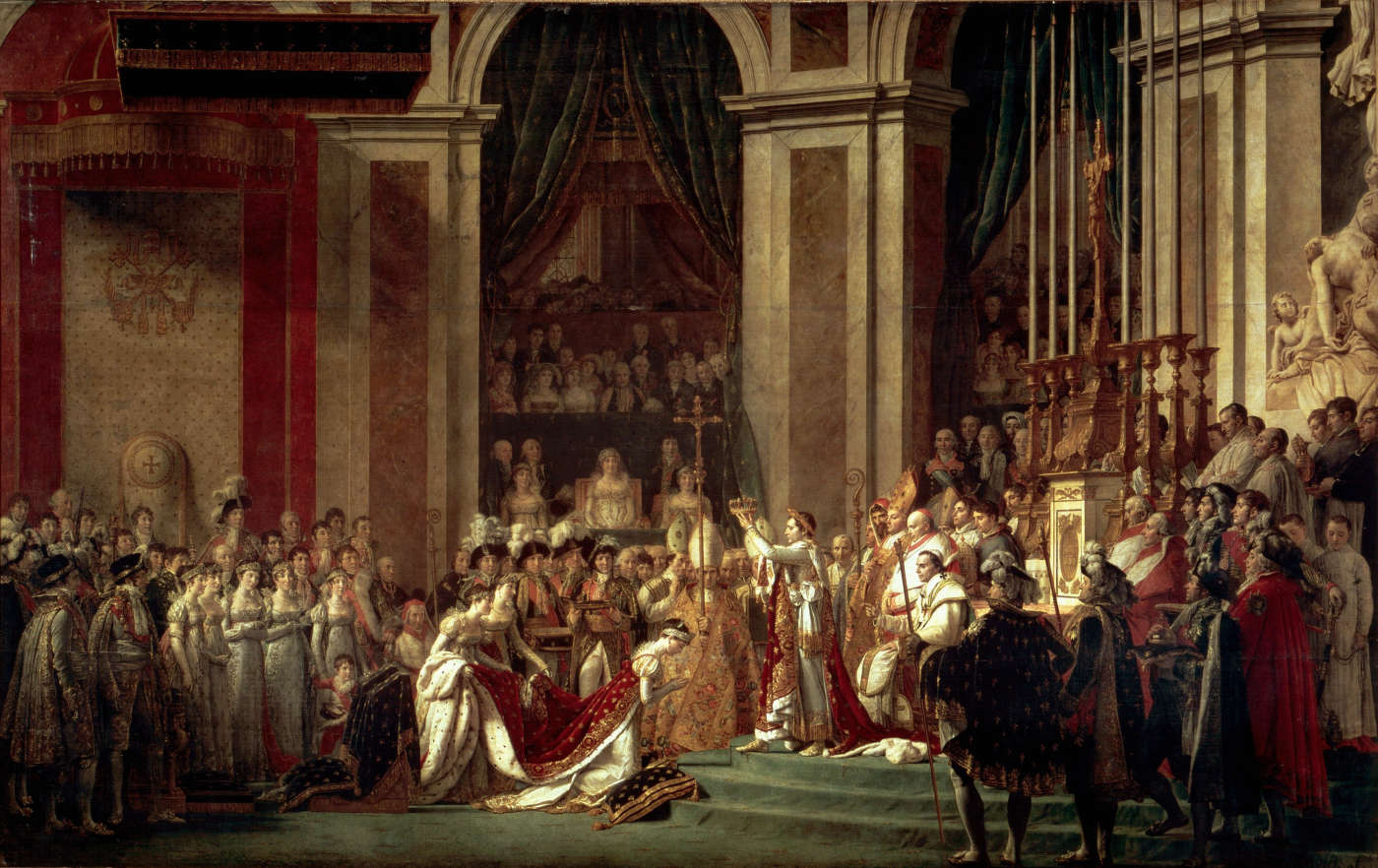
1. Jacques-Louis David- Le Sacre de Napoléon [The Coronation of Napoleon] (1805-1807)
Musée du Louvre in Paris, France


Who can deny the glory and the splendor of this painting?  I admit that my love affair with Le Sacre de Napoléon is unlike any other.  Measuring 6.21 by 9.79 meters, this is not a work you can accidently miss while traveling through the Louvre.  The attention to detail, the significance of the depicted event, the setting at Notre-Dame de Paris, the treatment of light and shadow, the architecture of its design and layout-- this is an unbelievable work of art.  One's eye is immediately drawn to Napoléon, the clear subject of the painting and symbol of France.  The painting also includes several notable characters, such as Joséphine de Beauharnais, Pope Pius VII, Louis Bonaparte (Napoléon's father), and Charles Bonaparte (Napoléon's elder brother).  I was also taught that Jacques-Louis David can be found in the balcony.  I mentioned earlier that I valued Renoir and Monet for their attention to the value and role of architecture.  David is no different and even better.  Like the majority of his works, Le Sacre de Napoléon is organised by several axes that run through the painting, thus clearly following the rules of neoclassicism, an artistic and architectural movement that lasted from the mid 18th century through the end of the 19th century.  While neoclassicism is commonly associated with Ancient Greece and Ancient Rome, David chose to depict the coronation of Napoleon, thus claiming this event as one of the utmost importance in the history of civilization.  As the official painter of Napoléon, David was certainly doing his job well.
Naturally, upon arriving at the Louvre, this painting was the first on my list.  In hindsight, I regret rushing to see it, for every painting that I viewed after Le Sacre de Napoléon was met with much less awe-- to me, nothing compares to this painting's greatness.  I remember weaving through the crowds--the hoards of tourists that flock to Paris during the summer--brimming with excitement and anticipation, and it was surely everything I dreamed of and more.  I stood facing the painting, dwarfed by its scale and size, my eyes welling up with tears imagining David watching such a momentous event in the history of France, a country I had grown to love so much.  It was almost surreal, but it was irrefutably an unforgettable experience-- one that I am eager to relive upon returning to Paris this fall.

Tuesday, May 25, 2010

No. 7, "Untitled"

Untitled

Violets in an open park,
Honey held out in your hand,
I am the bee,
So sweetly, so softly
Buzzing for you from afar

As if you could hear my
Troubled heart.
But I cry out all the same,
Pleading, praying
For the tenderness of touch

Almost like my life had
Lost its meaning in a
Darkened room—lost.

But I am not lost,
For you have found me.
Only in your discovery
Of my wailing heart
You have, in turn,
Lost yourself in this maze,

A maze with a constant fog,
A maze of abandoned pursuits
Much like me—an unfinished
Book on your shelf.

But gone are my wings,
My vibrant tone of summer yellow.
For under this suppressive cloak of
Winter, I have lost the life within me.

And you, in your sea of wilting flowers
Have let the spring take leave unquestioned
And have become a stranger
To the world around you.
- LMG

Monday, May 24, 2010

No. 6, Round One: Albert Camus

And so it begins: summer reading.  I always overestimate the time I will be able to allot to leisurely reading, so my list only gets longer and longer as the summers pass.  This summer, however, I am taking a different approach that will, hopefully, make this annual endeavor a tad more successful.  Three rounds, three writers: one writer I have longed to explore further; one writer I have never experienced; one writer I plan to revisit.

Round One: Albert Camus.

I shall commence with a collection of works by the great Albert Camus: La Peste, La Chute, and L'Exil et le Royaume.  While I have read L'Etranger, Le Mythe de Sisyphe, and short stories such as L'Hôte, I am ashamed to admit that I have not delved deeper into his oeuvres.  I consider Camus to be one of my favorite authors--an exclusive list of which any author should be honored to be a part.  I admire the way he writes and illustrates his characters; no detail escapes him, for like a detective, he reveals even the most seemingly trivial elements and proceeds to meticulously weave them into the story.  I consider Camus the "existentialist" (though Camus rejected the label) version of Honoré de Balzac--another of my most esteemed writers--for he fuses the realms of realism with l'Absurde, which, en bref, results from the conflict between the meaninglessness of the universe and one's failed search for meaning within it.  Camus describes the solutions to this dilemma as: (1) suicide (l'évasion de l'existence), (2) belief, either religious or spiritual, in a transcendent being, or (3) the acceptance of the Absurd, for which Camus himself advocated.

I highly recommend reading any work of Camus to anyone who has never done so as well as to those who have not done so recently, perhaps in the past few years or so.  Though I young, it seems that every time I have read L'Etranger or Le Mythe de Sisyphe, I feel differently about Camus' message.  Certainly this can be said about any novel or short story one has not read for a decade or two, yet I believe that the concepts and thoughts encompassed by l'Absurde and existentialism are worth revisiting and provide great insight to one's personal development-- both mentally and emotionally.  This does not mean that one must agree or disagree with these movements, but rather reflect on them with the hope that they will shed a light on one's personal journey and search for meaning in life.  Of course one could read Camus for pleasure as well, but I maintain this would only be denying oneself a fantastic experience of philosophical contemplation... and what a perfect summertime adventure-- no money, no planes, no tourists!

Saturday, May 22, 2010

No. 5, "A Never-Ending Season"

A Never-Ending Season

Love in its purest form:
I find you in the steam that
Rises from my tender-tinted tea,
Stroking the contours of my face,
Filling my passion-filled body with
A soft sense of ever-blooming warmth.

I fiddle with the collar of your oven-worn shirt
As you stare with a familiar profoundness into my eyes,
Memorizing the lines on my skin and their luring
Imperfections that hint at the stories of my past.

And as I lose myself in the shadows that mark
And define your face, I stumble into your accidental
Charm once more, drifting into an overpowering love-sea
And yet resisting any thought of swimming ashore.

I wish never to be found, to remain an
Ever-constant prisoner to this forbidden love,
That these chains—eternally strong—will see us
Through the torments of the blinded world.

Although the paths that map your face may
Fade away or change, the journey of our love
Will neither falter nor travel astray, for the
Gentle beatings of two destined hearts beat as one in
 A never-ending season.
- LMG

Thursday, May 20, 2010

No. 4, À Quoi Ça Sert L'Amour?

There is nothing like romance-- or so I've heard.  Though I am still young, I have yet to experience a romance of my own... or rather, one that is mutually felt.  Yes, I am hopelessly infatuated with Joshua Radin and besotted with Matthew Morrison, yet I understand that such worship will not yield my fantasized results.  From the first day of high school, I was not-so-secretly enamored of a guy in my class.  I am almost certain he knew it, and I regret not taking charge of my emotions.  Being the shy and reserved person that I am, I continued to admire him from afar throughout my four years of high school, after which we headed to different universities and embraced the next chapters of our lives, and I have not seen him since.

Clearly, I have plenty of time to meet "the one," but the abundance of romantic films and books as well as the tales of heartbreak and happiness confessed through music makes it that much more difficult to lead a life without such experiences.  Actors, writers, and singers illustrate the pain and pleasure of the heart as integral elements of their lives.  And how could they not be?  Love is a powerful thing-- a thing that can destroy and restore, ruin and complete, kill or revive.  What's the harm in desiring such passion?  I say none.  And I am willing to wait for it.


As a result of the inspiration of films I have seen, books I have read, and songs I have heard, I recently began crafting a short story.  While I only have two paragraphs thus far, I think there's "something there."  Clearly I have been swayed by the way that our cultures portray love (in any of its forms).  Yet I believe that even those of us who have yet to experience love can still have something to say about its powers, especially the those that we wish to one day feel for ourselves.
___

            Betrayal in its purest form—I opened my heavy eyes and gently peered at the familiar body that silently lay beside my own.  I would not disturb him.  He lay there with an expression filled with innocence and peacefulness that I could not dare alter.  And although he was not my husband, I did not consider myself an adulteress, for such a term was far too severe for the sin I had committed in the guilty hours that had so quickly passed.  But as I sat there upon the wintry sheets with my back leaned against the frozen, tangled bars of the bed frame, a prodding feeling hinted at my conscience, forcing me to leave the comforts of my unexpected indulgence.
            When my feet delicately stroked the dark wooden floor, the urge overtook me.  And despite the customary respect given to those who are asleep, I carefully climbed through the off-white linens towards him.  After spending what seemed like hours memorizing his breathing patterns and gazing over the discreet twitching of his lips, I lightly dove down towards his cheek—just far enough for my hair to graze his neckline.  I felt a tender touch caress my arm—gliding up and down my skin in a way that relaxed every part of me.  And when I slowly guided my eyes toward the strokes affection, I saw that it was his hand accepting my presence and consenting to my almost-kiss.  With the weakness of a morning body, he lifted his head up towards mine.  Our lips connected and briefly held onto one another, reminding us of the heartfelt hours we had wrongfully shared according to morality.

No. 3, "Purple Violets"

I consider myself to be rather knowledgeable in the area of cinema.  Over the past few years, I have been slowly building my French film collection to which I most recently added "Les Amants Reguliers," a film by Philippe Garrel and starring his son, Louis Garrel, as well as Clothilde Hesme.  I am a great fan of the works of Wes Anderson, Jean-Pierre Jeunet, Christophe Honoré, Alfred Hitchcock, and Woody Allen, to name but a few, all of whom have gathered sizable fan-bases and devoted followings-- and rightfully so.


Anyone who knows me is aware of the fact that my list of "favorite films" is endless; once I name one, another must be identified:  "The English Patient" is gorgeous; "West Side Story" is a classic; " "It's a Wonderful Life" is a masterpiece; "2 Days in Paris" is hysterical.  I could go on for days naming films that range from box-office triumphs to overlooked treasures and will stop at nothing to prove their cinematic value to anyone who will listen.


"Purple Violets," released in 2007, is a small-budget, independent film written and directed by Edward Burns ("Saving Private Ryan," "Life or Something Like It").  The film was the first feature film to debut on iTunes, skipping the theaters with the intention of appealing to a crowd that has (unfortunately) begun to drift away from the "movie-theater experience."  The film stars Burns alongside Patrick Wilson, Selma Blair, and Debra Messing and centers on these four individuals, all of whom were friends in college.  Since graduating, Patti (Blair) and Kate (Messing) have remained best friends as have Michael (Burns) and (Brian) Wilson, and the story takes off after a chance meeting in a Manhattan restaurant where Patti and Kate are celebrating Kate's birthday.  This serendipitous encounter reveals to Michael that Kate was the love of his life as well as rekindles the relationship between Patti and Brian despite Patti's marriage.  The film follows the four characters and captures the life changes that ensue in a profoundly intimate and graceful way, relying on the sensitivity of the heart to lead the viewer on a journey of personal discovery along with the story's four protagonists.


I recall opening iTunes on the day of the film's release and being greeted by an advertisement for the film, which modestly identified itself with a black typewriter beneath the title, "Purple Violets."  I clicked on the image and found the equally modest cast list; yet, as a fan of all four actors, I was pleased with what I saw and did not hesitate to cough up the $14.99 to purchase the film.  "Purple Violets" is labeled as a romantic-comedy, but I believe it much too poignant and meaningful to be categorized with films such as "Forgetting Sarah Marshall" and "There's Something About Mary."  There is something so honest and pure about the characters, their desires, and their connections to one another that sets this film apart from the average "date-night" flick.  I recently discovered that "Purple Violets" has been played several times on HBO-- a pleasant surprise, indeed.  I do hope that more people make an effort to see this film.  Sure, it is not "ground-breaking cinema," but any avid "movie-goer" will appreciate the delicate and detailed simplicity of the film and its story.  While it was later released on DVD, I continue to regard this film as an "overlooked treasure," and perhaps you will agree.

Monday, May 17, 2010

No. 2, "Rejuvenation"

Packing and unpacking has its pros and cons.  Although it is a wearing and an exhausting process as a whole, I do treasure the forgotten items I stumble upon along the way.


Those who know me well are aware of the fact that while my short stories and prose are generally comical and positive, my poetry is quite the opposite-- often depressing and dark.  I never understood why my poems communicated somber messages, but I have always been very proud of my work despite the worry or concern it has provoked in others (teachers, mainly).  Yet, again, those who know me can attest to the fact that these poems in no way reflect my personality; au contraire, I have always valued and utilized the power of comical relief, often at my own expense.


While reorganizing my bookshelf last night, I discovered an old journal in which I would write poems that suddenly came to mind.  Every few weeks, sometimes months, I would come out of a dream inspired.  At two or three o' clock in the morning, I would sit up in my bed, reach for my journal, write for fifteen minutes, and promptly fall back onto my pillow.  In the morning, I would wake up to find my journal under the pillow, on the floor--somewhere in the vicinity of my bed--and was always surprised to discover that my scribblings were, in fact, coherent and, generally, meaningful.


One of the poems that I discovered in this journal, "Rejuvenation," is one that I wrote upon returning from Paris last summer.  Despite the jet lag and my longing for la France, I managed to piece this poem together.  Like most of my poetry, the beginning is grim; yet, what struck me most was the fact that, in contrast to my usual poems, Rejuvenation ends on a strikingly more optimistic note, perhaps reflecting my anticipation for my year abroad.


As a very appropriate theme for the beginning of summer, a time when we can relax, reflect, and slip in to rêverie, "Rejuvenation" illustrates a welcomed beginning in a time when it is most needed:


REJUVENATION
Petals pressed between the pages,
Leaving behind the scent of a better time--
When life was not a game of choice and chance
But a predestined path of intent and ambition.
Perhaps I am from another era,
Floating between the years of past and future,
Worried of what has been missed
And what is yet to come.
Yet what I seek has failed to appear,
Withholding the sense of pleasure and purpose
That is sure to make my life complete.
Instead of breaking from their brittleness,
The petals strengthen, drawing vitality from the
Freshness of the surrounding air-- rejuvenation.
The cycle is not complete, but rather, it has start anew,
Beckoning the morning dew of tomorrow.
- LMG

Saturday, May 15, 2010

No. 1, Introduction

It is with much excitement and enthusiasm that I begin this blog.

My summer vacation has just commenced, and I am overwhelmingly ready to begin the next chapter of my life.  After working as an intern in the curatorial department in a local university's art museum this summer, I will leave Texas and embark on a year-long adventure en France-- Paris, more specifically.  I have awaited this experience for as long as I can remember and plan to use this medium of expression as a way to capture and share the experiences of my life thus far as well as all that lies ahead of me in Paris and beyond.

In order for you, the reader, to become better acquainted with me, my writing, and my passions for France and architecture, below is a little piece I recently wrote for a beautiful and gorgeously written blog, GrandsAmours, by an equally wonderful woman, Sara, who I had the great fortune of meeting several years ago in Nice, France.

I look forward to sharing my thoughts and stories with all of you as well as wish you bonne nuit and happy reading!

_______

            L’euphorie—a feeling that can only be felt in Paris.   The architectural grandeur, the cuisine and, bien sûr, the general atmosphere that radiates off the hidden streets and winding pathways all create an experience unlike any other.  I generally shy away from clichés, but Paris truly is magical.  As a French major, I have learned that it is one thing to love French and quite another to love la France.  And furthermore, admiring Voltaire or Flaubert is not the same as admiring le jardin du Luxembourg or l’Eglise Saint-Paul-Saint-Louis—one of my all time favorite churches on rue Saint-Antoine in the quatrième.  While I have only been to Paris twice, the self-discovery I have achieved in these two contrasting experiences is indispensable to my identity.
            During my first stay in Paris, I was participating in an academic program, which culminated in a  four-day trip to explore as much as possible in as little time as possible.  No time to sleep, even less time to eat, and a regrettable avoidance of the métro made for a stressful “séjour,” but we somehow managed to fit visits to les grands musées—the Louvre, Musée d’Orsay, and Musée Picasso, to name a few—as well as Notre-Dame de Paris, Sacré-Coeur, the Tour Eiffel.  Yet our chaotic itinerary left little time for self-reflection.  I could appreciate the unmistakably different way of life.  Clearly, the glory of the Tour Eiffel and built environment of the city were moving, but I found myself unable to differentiate between the feelings of being impressed and being inspired.  But by the time my understanding began to flourish, I was on a chartered bus en route to Charles de Gaule where a flight to Dallas/Ft. Worth awaited me. I resented my return to reality—of that I was sure—and anxiously awaited my next trip that would not come for three more years.
            Upon returning to Dallas just in time for my senior year of high school, I immersed myself in French, Paris, France—anything and everything I could get my hands on.  I dreamt of a life in Paris, a love affair with Guillaume Canet, and of acting in a Jean-Pierre Jeunet film.  As time passed, I continued to feed this unquenchable desire for la vie à la française.  The most important contribution to my passion for la France was architecture.  I began to study architectural history when I arrived at university.  My research projects focused on the cathedrals of France, leading up to my greatest research endeavor: the study of imperial architecture in Paris and Algiers during the reign of Napoléon III.  It was during the rule of Napoléon III—aka, Louis-Napoléon—that Paris as we know it was formed.  Following a comprehensive makeover and the “necessary expulsion” of les pauvres de la ville, iconic landmarks like Notre-Dame de Paris and l’Opéra Garnier were intentionally framed by the newly organized streets of Paris, thus creating a city that spotlighted the strength and expertise of France’s architecture as well as the urban planning orchestrated by architects like Baron Haussmann.  While it is certainly not necessary to view Paris from an architectural perspective, for me, the ability to merge these two passions—architecture and France—contributed to an unparalleled experience during mon deuxième séjour.
            Victor Hugo once said, “Architecture has recorded the great ideas of the human race.”  As a writer who relied greatly upon architecture—both in its literal, physical form and its role in constructing a novel—and who serves as one of the great literary representatives of France, it is hard to deny the truth of Hugo’s words.
            I returned to Paris this past summer and was fortunate to stay with my best friend, Juliette, and her family who live in a remarkable 18th century flat in the seizième.  Juliette worked four out of the six days of my stay, so I prepared myself for the second round of adventures on which I would be embarking. Naturally, I made it a point to visit the more “touristy” places I had yet to see, but I also formed a list of every chapel, church, and cathedral in Paris and was resolved to visit as many of them as possible—if not all.  I am not devoutly religious (and neither is France, for that matter), but the religious monuments of Paris communicate a spiritually impressive experience unlike any other city I have visited.  From the overwhelmingly ornate design of la Sainte-Chapelle to the more modest façade of l’Eglise Saint-Séverin, each of these sacred settings emphasize the mystical qualities of Paris and prove—either by the views of the city landscape or the exquisite artwork and stained glass of the interior—that Paris is, in fact, a city that will change your life.
As I sat in one of the pews at l’Eglise Saint-Paul-Saint-Louis, the last religious site on my checklist, I began to sketch my surroundings, moved by the design and its attention to detail.  A man standing beside me slowly bowed over to remark, “C’est formidable, non?” I enthusiastically nodded and added, “C’est la plus belle église que j’ai vue de ma vie.”  He introduced himself as Thierry and proceeded to ask me why I believed so, and I tried to explain my reasons in architectural terms as best I could.  He was curious to know why I did not prefer the Sainte-Chapelle with its grandiose stained glass and ornamentation or Notre-Dame de Paris with its breath-taking view of the cityscape.  I was a bit taken aback when Thierry’s question made me realize that l’Eglise Saint-Paul-Saint-Louis matched none of the criteria upon which I had been taught to consider religious architecture.  Quelle ironie!  There is just enough light to sufficiently light the interior of the église and certainly a generous amount of ornamentation—carvings, gold, and embellished chandeliers—yet there was a distinct and almost-perfect balance of overall grandeur and the inwardly focused personal experience on a human scale.  And it hit me that this realization encompassed, for me, the meaning of Paris.
Paris generates euphoria.  For me, this state is inspired by the architecture.  For others, it is provoked the boutiques, the pastries, or simply the act of being un flâneur, an idler with no intention other than aimless exploration.  Architecture tells the story of a place and its people and, in doing so, creates the identity that evokes such feelings as freedom, amusement, or inspiration.  Winston Churchill (though not French) noted, “We shape our buildings; thereafter they shape us.”  The built environment shapes who we are and the experiences we have throughout our lives whether they are as memorable as one’s first visit to le Tour Eiffel or as quotidien as a quick trip to the marché.  There are multiple reasons that Hemingway, Fitzgerald, and numerous American writers flocked to Paris; however, the one that is most important—and that I most intimately understand—is the craving for a different setting that would kindle inspiration, evoke new feelings, and contribute to one’s identity in ways that would forever change one’s outlook on life.  A place that would summon l’euphorie—Paris.