
Next week, I will be beginning my summer internship at the art museum of a local university. I am greatly looking forward to this experience and all that I will learn. I woke up this morning thinking about art, more specifically, the paintings that have most profoundly affected me during my life thus far. I was surprised to discover that not one of my "top five paintings" had ever been explored in any of my art history courses. While the painters themselves have had several classes dedicated to their works, I discovered my favorites either on my own or by the recommendations of others.
5. Pierre-August Renoir- Doge's Palace, Venice (1881)
Clark Art Institute, Williamstown, Massachusetts

This painting is quite stunning. While I adore the realms of art and art history, I have to admit that my passion runs even deeper for architectural history. When analyzing the gothic palace through the lens of architecture, the Palazzo Ducale di Venezia is a remarkable example of a structure that clearly expresses its meaning and value through its design. As the residence of the Doge of Venice, the palace is of great importance, which is evident through the tower that rises well above the surrounding buildings. Located in Piazza San Marco, the principal square of Venice and a great attraction to visitors, the presence of the Doge's Palace is undeniable; the arcaded windows echo the waves of the Laguna di Venezia, a key element of Venice's maritime empire, which continues to serve as a base for a seaport.
In this painting, Renoir captures the majestic wonder of the Palazzo Ducale-- its setting, design, and significance. Many know Renoir for paintings such as Bal du moulin de la Galette (1876), Le Déjeuner (1880-1881), and, more generally, the way in which he captures the emotions of the people spotlighted in his works. Yet I feel that his illustration of Doge's Palace is refreshing; aside from the absence of humans, Renoir asserts that architecture can stand alone as the subject of a painting. And he is right, for architecture is the reflection of not only the people that design the buildings but also those who live within the built environment of their villages, towns, and cities.
4. Claude Monet- La Série des Cathédrales de Rouen (1892-1893)
[found in various museums around the world, including Musée d'Orsay in Paris, France, National Gallery of Art in Washington D.C., and Pola Museum of Art in Hakone, Japan]


Cathédrale Notre-Dame de Rouen is a mesmerizing site and, apparently, Claude Monet agreed. The construction of the cathedral lasted from 1202-1880 and held the reign of tallest building from 1876-1888, yet it suffered damage from two bombings in World War II. In this project of more than thirty paintings, Monet pursued his interest in light, capturing the façade of the cathedral at various times of the day in order to illustrate the way in which light provides discrete perspectives. Monet, like Renoir, proves to the spectator that architecture can play the main role in a painting as well as the existence of the "in-betweens" that link "night" and "day."
I have a weakness for gothic cathedrals, and Rouen Cathedral is no exception. This collection is breathtaking and clearly exposes the architectural grandeur of the cathedral at all points of the day. Even though Monet is better known for Le Déjeuner sur l'herbe (1865-1866) and Les Nymphéas (1920-1926), I believe that the Rouen Cathedral series equally demonstrates his artistic prowess and magnificence.
3. Claude Monet- Les Nymphéas (1914-1926)
[specifically, the eight pieces at Musée de l'Orangerie in Paris, France]


However, I must say that Monet's Les Nymphéas are gorgeous. A series of 250 oil paintings, les Nymphéas depict the flowers and sites of Monet's flower garden at Giverny, again a varying times of the day. While the paintings are scattered throughout the world, eight of the paintings are spotlighted at the Musée de l'Orangerie in Paris. On the lower level of the museum, after passing through the vestibule space, there is a series of two salles dedicated to the display of these paintings. The paintings-- the largest of which measures 200 by 1700 cm (Les Deux Saules)-- embrace the viewer by hugging the shape of the room much like pronounced wall paper. Each of the works are visually stunning in their own respective manners, creating an experience inundated with tranquility and awe through the color palette and scale of the paintings.
I clearly remember my first visit to the Musée de l'Orangerie during my first visit to Paris after completing a language immersion program in Nice. One of my friends from high school, Annie, was studying in Paris at the time, and we arranged to meet up at the museum, which had been closed from August 1999 until May 2006 and, thus, had recently reopened to the public with a new design and the special addition of the Nymphéas exhibit. To celebrate the reopening, more than sixty of the Nymphéas paintings had been gathered from around the world, creating an inspiring stage for Monet's work.
2. Raoul Dufy- La Fée Électricité (1937)
Musée d'Art Moderne de la Ville de Paris in Paris, France

Where do I begin? I was introduced to this painting, as well as this museum, by my best friend, Juliette, during my last stay in Paris. Dufy is, I believe, Juliette's favorite painter, so I am sure she is happy to know how great of an impression this painting made on me. La Fée Électricité has its own room in the Musée d'Art Moderne de la Ville de Paris (as it very well should), providing ample space for visitors to stare in wonder at the enormity of the painting. Created for the "Electricity Pavilion" at the International Exposition in 1937, La Fée Électricité stood as the largest painting in the world that was independently supported at 624 square meters. The painting consists of 250 pannels of plywood, each of which measures 2 by 1.20 meters. The painting depicts 100 savants, all of which are associated with the development of electricity. Dufy's color palette is stunning-- to say the least. In fact, I remember having a hard time believing that the medium was oil paint, for it gives off such a light and glowing aura that it appears to resemble the effects of watercolor. But perhaps that can be attributed to the fantastic arrangement of lighting within the space, which can truly enhance or destroy the power of the painting.
This painting is a treasure and certainly worth a visit, as is the rest of the museum, which is linked to the Palais de Tokyo in the 16ème.
1. Jacques-Louis David- Le Sacre de Napoléon [The Coronation of Napoleon] (1805-1807)
Musée du Louvre in Paris, France
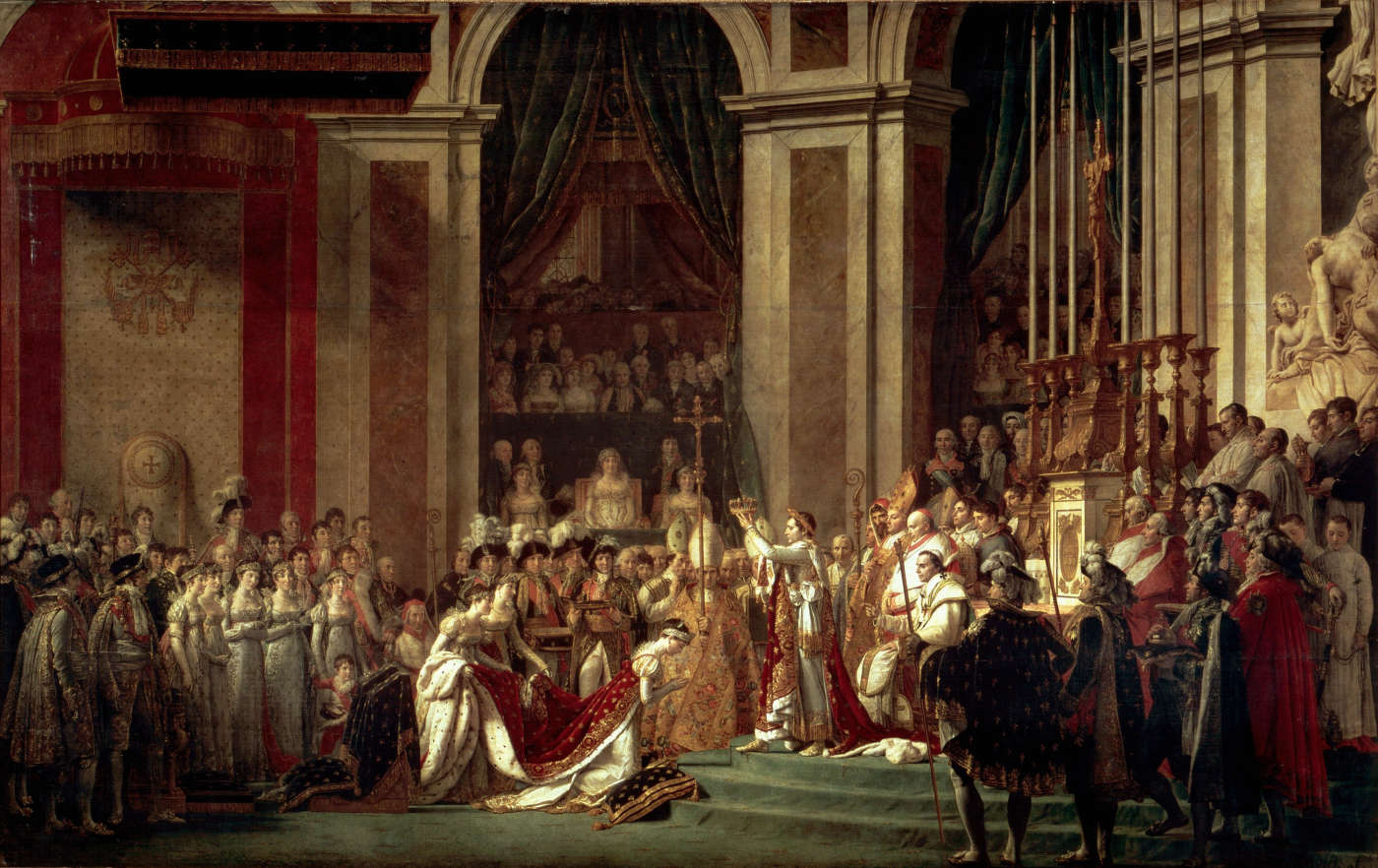
Who can deny the glory and the splendor of this painting? I admit that my love affair with Le Sacre de Napoléon is unlike any other. Measuring 6.21 by 9.79 meters, this is not a work you can accidently miss while traveling through the Louvre. The attention to detail, the significance of the depicted event, the setting at Notre-Dame de Paris, the treatment of light and shadow, the architecture of its design and layout-- this is an unbelievable work of art. One's eye is immediately drawn to Napoléon, the clear subject of the painting and symbol of France. The painting also includes several notable characters, such as Joséphine de Beauharnais, Pope Pius VII, Louis Bonaparte (Napoléon's father), and Charles Bonaparte (Napoléon's elder brother). I was also taught that Jacques-Louis David can be found in the balcony. I mentioned earlier that I valued Renoir and Monet for their attention to the value and role of architecture. David is no different and even better. Like the majority of his works, Le Sacre de Napoléon is organised by several axes that run through the painting, thus clearly following the rules of neoclassicism, an artistic and architectural movement that lasted from the mid 18th century through the end of the 19th century. While neoclassicism is commonly associated with Ancient Greece and Ancient Rome, David chose to depict the coronation of Napoleon, thus claiming this event as one of the utmost importance in the history of civilization. As the official painter of Napoléon, David was certainly doing his job well.
Naturally, upon arriving at the Louvre, this painting was the first on my list. In hindsight, I regret rushing to see it, for every painting that I viewed after Le Sacre de Napoléon was met with much less awe-- to me, nothing compares to this painting's greatness. I remember weaving through the crowds--the hoards of tourists that flock to Paris during the summer--brimming with excitement and anticipation, and it was surely everything I dreamed of and more. I stood facing the painting, dwarfed by its scale and size, my eyes welling up with tears imagining David watching such a momentous event in the history of France, a country I had grown to love so much. It was almost surreal, but it was irrefutably an unforgettable experience-- one that I am eager to relive upon returning to Paris this fall.


No comments:
Post a Comment