
My love for film is one of the constants in my life. About four years ago, I began collecting French films and have been slowly adding to my collection ever since. I adore The Criterion Collection despite the high prices, for the bonus features are generous and often include conversations with the director, actors, storyboards, etc. Film has the unique ability to have a profound influence on one's views of life and the world as well as conjure up feelings of nostalgia, happiness, and sadness with little effort. These are the ways by which consider my favorite films-- their meaning(s) and their effect(s). In building a list of my favorite films, I originally aimed for five, which turned into ten, which ultimately turned into fifteen. I could easily continue on to thirty or perhaps fifty, but I feel that these fifteen effectively capture the value of film in my life. However, I will only elaborate on my top five for the sake of the reader, especially considering the endless amount of praise I can give for each of these phenomenal films.
1. The English Patient (1996)

I remember being floored by the cinematography and the screenplay (which I own). Every scene is lit perfectly, making the desert and a run-down monastery appear divine and surreal; every line is so intense and sincere. At the end of the film, Hana reads a message that Katharine had written to Almásy, which happens to be one of my favorite quotes from the movie:
Katharine: "My darling, I'm waiting for you. How long is a day in the dark? Or a week? The fire is gone now, and I'm horribly cold. I really ought to drag myself outside-- but then there would be the sun. I'm afraid I waste the light on the paintings and o writing these words. We die, we die rich with lovers and tribes, tastes we have swallowed, bodies we've entered and swum up like rivers, fears we've hidden in like this wretched cave. I want all this marked on my body. We are the real countries are, not boundaries drawn on maps with the names of powerful men. I know you will come carry me out to the palace of winds. That's what I've wanted-- to walk in such a place with you, with friends, on an earth without maps. The lamp has gone out, and I'm writing in the darkness."
2. Rushmore (1998)
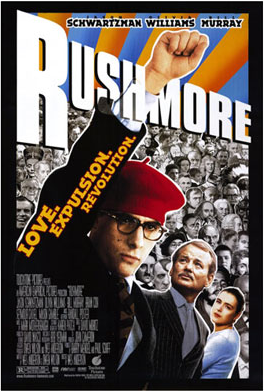
The Film centers on Max Fischer, an eccentric fifteen year-old, and his relationships with Herman Blume (Bill Murray), a snobby, rich industrialist, and Rosemary Cross (Olivia Williams), an elementary school teacher at Rushmore Academy (where Max is a student) with whom both Max and Herman are in love. Max finds greater success in extracurricular activities than academics, yet he is completely devoted to Rushmore. He becomes close friends with Herman Blume, finding him inspiring, as well as becomes infatuated with Ms. Cross and proceeds to make attempts at impressing her and attracting her attention in any way. However, due to one of his plans, Max is ultimately expelled from Rushmore, forcing him to attend public school. Without giving the story away, the film continues to follow Max, spotlighting the way he adapts to his new school and the realizations he makes about Herman Blume, Rosemary Cross, life, and, most importantly, himself while fostering his talent as a playwright.
Everything about this film is ideal-- the casting, the screenwriting, the soundtrack, etc. This is one of my top "go-to" films after having a bad day; the story and characters are so real, and the film succeeds in engaging the viewer without being overwhelmingly dramatic or comical--though "Rushmore" is most definitely hysterical, but in a "down-to-earth" sort of way. Much like I felt after watching "The English Patient" for the first time, after viewing "Rushmore," I knew that it would be a film that I kept by my side for the rest of my life. I always recommend it to friends, for it is only 93 minutes and is, I believe, a film that anyone can appreciate if given the chance.
The soundtrack is certainly one of the movie's strongest points; Mark Mothersbaugh is a musical genius, and each of the songs selected for every Anderson film soundtrack, especially "Rushmore," is perfect. The scene in which Max plays Yves Montand's "Rue St. Vincent" in an attempt to almost-seduce his teacher is simultaneously comical and poignant, and the final song before the credits, "Ooh La La" (The Faces), always makes me smile, for it plays during the final scene of the film where all conflicts are resolved and all of the characters experience a moment of collective contentment.
While I feel that Wes Anderson and Jason Schwartzman should have their separate identities, the two really do go together (for me) because of this movie, as well as the fact that it launched Schwartzman's career. While Schwartzman has not been involved in all of Anderson's projects, I believe that my connection with Wes Anderson's films can be attributed to the recurring collaborators: Angelica Huston, Bill Murray, Mark Mothersbaugh, Luke Wilson, Owen Wilson, Kuman Pallana, and so forth. This creates a feeling of familiarity that builds a relationship with the viewer, making one feel like part of "the family."
When "The Darjeeling Limited" (2007) was released in Dallas (along with the short into film, "Hotel Chevalier"), I attended the premiere and Q&A session for the film, which Jason Schwartzman attended. Schwartzman contributed as a writer (as well as an actor) along with Anderson and Roman Coppola, Schwartzman's cousin. Schwartzman discussed the experience of filming the feature on an actual moving train as well as shared some insight on the writing process. "The Darjeeling Limited" features an exquisite soundtrack and brilliant cast--like all Anderson films. But the film demonstrates the profound effect of color through clothing, landscapes, and people, making the film far more visually striking than all preceding Wes Anderson projects. Yet I maintain that Wes Anderson has an unparalleled talent in writing and directing, which is responsible for his large and dedicated following of which I am proud to be a part.
3. Le Fabuleux Destin d'Amélie Poulain (2001)

"Amélie" follows a shy waitress in the district of Monmartre in Paris as she performs little acts of kindness to change and improve the lives of others while also figuring out her own life. Amélie was mistakenly diagnosed with a heart defect as a child, forcing her parents to home-school her and, thus, separate her from other children, isolating her from the world. At the age of six, Amélie's mother dies in a freak accident, after which her father dedicates his life to creating a memorial in their garden for his late wife. Even more alone than before, Amélie confronts her solitude with her active imagination. The story fast-forwards, and we find Amélie as a young woman who has experienced several failed romantic relationships and, as a response, immerses herself in life's simple pleasures. One evening, Amélie finds a metal box behind a bathroom tile and becomes resolved to return it to its rightful owner. Amélie meets several characters along the way, including Raymond Dufayel, a painter with a brittle bone condition, who assists Amélie in tracking down Dominique Bretodeau, the owner of the box. After successfully, yet anonymously, returning the box, Amélie is inspired to continue with these deeds of kindness, for she finds happiness in her actions. The film continues to follow Amélie on her journey of personal growth as she not only makes other people happy but also finds love for herself.
The film is a treasure and truly sincere; it is unique--to say the least--and makes even the most mundane details of the everyday seem magical and captivating, which, I believe, makes "Amélie" so special. It is a "feel-good" film on a completely different level than all others. Rather than feeling uncomfortable and disoriented by the surreal style of filming and the eccentric visual effects, "Amélie" invites and embraces the viewer, bridging an intimate connection between Amélie's and the viewer's subsequent self-contentment.
Other Jeunet films that I adore are: "La Cité des enfants perdus" (1995) and "Un long dimanche de fiançailles" (2004). "La Cité des enfants perdus" is a dark, fantasy film while "Un long dimanche de fiançailles" tells the romantic tale of a woman (Audrey Tautou) in search of her lover who went missing during World War I. Although "Un long dimanche de fiançailles" is more morbid and heart wrenching than Jeunet's other films, it still captures the same determination and passion for which Jeunet is known. Jeunet recently released the film "Micmacs," which has been well received and enjoyed by moviegoers and critics alike, and is certainly on my must-see list for the summer.
4. 2 Days in Paris (2007)

Julie Delpy's character, Marion, narrates "2 Days in Paris," a story about Marion, a French photographer, who is returning from a romantic trip to Venice with her American boyfriend, Jack (Goldberg), and plans to spend two days in Paris with Jack before heading back to New York. Marion is assertive yet insecure while Jack is neurotic, a hypochondriac, and, as it turns out, insecure as well. In addition to the conflicts that arise from cultural differences and clashes, the couple is constantly running into Marion's ex-boyfriends and -lovers with whom, to Jack's surprise, Marion is still friendly and is in contact. The film follows these encounters and the way in which they impact Jack and Marion's relationship, which has its ups and downs throughout the movie.
While implementing humor to "spice up" the story, "2 Days in Paris" remains a deep and thoughtful examination of modern relationships and love, keeping the film as real and "down-to-earth" as possible, which, I feel, is the reason for its success. Delpy and Goldberg are a fun and very attractive pair, which could be attributed to their past romance as well as the fact that they are both phenomenal actors--and, in my opinion, under appreciated and overlooked in cinema. On another personal note, I really love the sound of Julie Delpy's voice; it is so distinctive, sincere, and reflective, and she narrates the film as if relating the story to a close friend, making me feel like I know her on a personal level rather than merely admiring her from the comforts of my couch. In 2009, Delpy released another film that she wrote, directed, produced, composed, etc, "The Countess," which tells the story of Erzebet Báthory, a powerful and fearsome Hungarian countess. Countess Báthory falls in love with a younger man whose father does not approve of their relationship and leads the Countess to believe that his son no longer loves her. This heartbreak forces the Countess on a murderous rampage, taking revenge on the beauty of the youth and believing that the blood of virgins will preserve her beauty. It is a dark and heartbreaking story that is beautifully interpreted and manifested by Julie Delpy, who portrays the Countess. Delpy shows the versatility of not only her filming and writing technique but also her talents as an actress.
Adam Goldberg is also one of my favorite actors. Best known for his role in "Dazed and Confused" (1993), "Saving Private Ryan" (1998), and "How to Lose a Guy in 10 Days" (2003), Adam Goldberg, like Delpy, is also a director, producer, actor, and musician. His current music group, "LANDy," is an interesting and entertaining project, and their debut album "Eros and Omissions" was released this past year ("BFF!" is a fantastic song).
Returning to "2 Days in Paris," I would like to bring this commentary to a close with the closing monologue of the film, which is quite poignant and well written. It will certainly be best appreciated after viewing the film, but these words give a potential viewer a good idea of the depth this film reaches.
Marion: "It always fascinated me how people go from loving you madly to nothing at all, nothing. It hurts so much. When I feel someone is going to leave me, I have a tendency to break up first before I hear the whole thing. Here it is. One more, one less. Another wasted love story. I really love this one. When I think that it's over, that I'll never see him again like this... well yes, I'll bump into him, we'll meet our new boyfriend and girlfriend, act as if we had never been together, then we'll slowly think of each other less and less until we forget each other completely. Almost. Always the same for me. Break up, break down. Drink up, fool around. Meet one guy, then another, f*** around. Forget the one and only. Then after a few months of total emptiness, start again to look for true love, desperately look everywhere and after two years of loneliness, meet a new love and swear it is the one until that one is gone as well. There's a moment in life where you can't recover anymore from another break-up. And even if this person bugs you sixty percent of the time, well, you still can't live without him. And even if he wakes you up every day by sneezing right into your face, well, you love his sneezes more than anyone else's kisses."
5. Moulin Rouge! (2001)
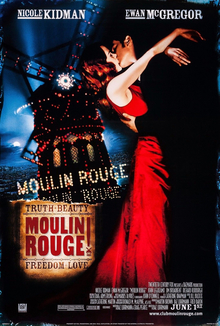
"Moulin Rouge!" is inspired by Guiseppe Verdi's opera "La Traviata" (coincidentally my favorite opera even before the release of "Moulin Rouge!") and tells the story of Christian (Ewan McGregor), an English poet and writer, who arrives in Paris in 1899, settles in the quarter of Montmartre, and pursues his writing career. He falls in love with Satine, an actress and courtesan at the Moulin Rouge, who ultimately dies, as we learn at the very beginning of the film. "Moulin Rouge!" follows the story of their passionate love and the transformation of the Moulin Rouge into a theater, made possible by the financial investment of the Duke (Richard Roxburgh), the villain of the story. Infused with well-known popular music, "Moulin Rouge!" is a move-musical that stands apart from all the rest. With song like Elton John's "Your Song," The Police's "Roxanne," and Queen's "The Show Must Go On," it is impossible to keep from singing, especially upon hearing the beautiful interpretations of these classics. "Elephant Love Medley" is the first song shared between Christian and Satine and is both catchy and heartfelt; it is comprised of songs like "All You Need is Love" (The Beatles), "Pride (In the Name of Love)" (U2), "Don't Leave Me This Way" (Harold Melvin & the Blue Notes), "Silly Love Songs" (Paul McCartney and Wings), and "Heroes" (David Bowie), to name a few. "Come What May" is known as the lovers' "secret song" in the film and is the movie's only original song, which went on to receive a Golden Globe nomination and is included on the AFI's 100 Year, 100 Songs list. It is an intense and emotional ballad that is sung twice in the film. However, the soundtrack, which consists of two volumes, is fantastic in general--a must buy for any music lover.
How do I begin to explain what "Moulin Rouge!" means to me? I was eleven when the film was released, and my mother, thinking I was too young decided it would be best to refrain from seeing it in theaters-- much to my dismay. However, soon after "Moulin Rouge!" was released on video, my mother, younger sister, and I watched the film and were left speechless-- jaws dropped, tears flooding down our faces, and hearts racing. Until this day, we still speak about the film as if it were a life-changing experience, which it truly was. My sister and I were immediately obsessed; I bought the sheet music and [poorly] sang all of the songs, and my sister would type up the script word for word on a typewriter that we bought shortly after being inspired by Christian's character in the film. For my sister's ninth birthday party, the house was decorated with screen-caps from the movie, and all of the girls were encouraged to dress up like the Moulin Rouge dancers-- certainly a nightmare to any parent other than my mother and father. Most of my friends from middle school and the majority of my high school-friends know me for my love for "Moulin Rouge!," and I am proud to be responsible for their conversions into part of the cult. In seventh grade, a few years after my love affair had begun, my class took a trip to New York City, and one of my fondest memories from the trip was walking through the city at night, arm-in-arm with my friend, Aviva, singing "Your Song," "Elephant Love Medley," and "Come What May" at the top of our lungs without a care in the world. My best friend Laura and I also share a love for "Moulin Rouge!," and we never hesitate to text one another when we are reminded of the film or are watching it, which I often am. My sister and I can still recite the film from start to finish, including its songs, and every time I watch "Moulin Rouge!," it brings me back to the first time all over again, and I never cry any less than the time before.
Nicole Kidman won the Golden Globe for "Best Actress" and is stunning both as an actress and as a singer, which she had never attempted at before starring in "Moulin Rouge!" Ewan McGregor is irresistable with an equally remarkable voice and his overwhelming sincerity. In addition to Kidman and McGregor, the casting choices as a whole could not have been better; Jim Broadbent ("Iris," "Bridget Jones' Diary") plays Harold Zidler, the owner of the Moulin Rouge, and John Leguizamo ("Carlito's Way," "Romeo + Juliet") takes the role of Henri de Toulouse-Lautrec.
One can see the phenomenal imagination of Baz Luhrmann at work throughout the film, fashioning a masterpiece of cinema, dance, and music that captures the hearts of viewers of any age, forming an intimate bond that is sure to last a lifetime.
"The greatest thing you'll ever learn is just to love and be loved in return."
6. West Side Story (1961)
7. Les Chansons d'Amour (2007)
8. Rear Window (1954)
9. Jeux d'Enfants (2003)
10. Basic Instinct (1992)
11. Annie Hall (1977)
12. The Way We Were (1973)
13. Les Parapluies de Cherbourg (1964)
14. Bridget Jones' Diary (2001)
15. The Sound of Music (1965)


Your blog is so beautifully written and inspiring! This entry was by far, my favorite! I especially enjoyed reading your commentary on "Moulin Rouge!"; moreover, I agree that it is a beautiful and majestic film that captures the meanings of freedom, beauty, truth and love. Perhaps your next entry could be one about your sister? She seems quite interesting ^.^!
ReplyDelete