Tuesday, August 10, 2010

LA RICHESSE DU MONDE HAS MOVED!

Attention all readers: LA RICHESSE DU MONDE HAS MOVED!

It has been a good run with blogger, but I have recently converted my blog to Wordpress.

I would like to thank you all for reading my posts and hope that you will continue to do so.  I will be leaving for my year abroad in Paris in three short weeks, so exciting posts and reports are soon to come!


Love to all and happy continued reading!

xo

Monday, August 2, 2010

No. 21, How This Summer Has Changed My Life

I sincerely apologize for the long break since my last post just a tad over a week ago.  I will be taking yet another break this week as I am going to Florida on a much-desired five-day vacation.

However, I would like to take this opportunity to sum up several parts of my summer-- a thought that was inspired by several quotes from Marcel Proust (more specifically, from my "bible," Alain de Botton's How Proust Can Change Your Life).


Sometimes in the afternoon sky, a white moon would creep up like a little cloud, furtive, without display, suggesting an actress who does not have to "come on" for a while, and so goes "in front" in her ordinary clothes to watch the rest of the company for a moment, but keeps in the background, not wishing to attract attention to herself.


Writing has been such an important part of my summer.  I would like to think that I have done a decent job in presenting topics--books, films, music, architecture, and art-- that have stimulated and encouraged any amount of interest or thought.

Blogging has been such a wonderful outlet to express myself and share my passions with my few, but dedicated readers, and has provided several wonderful experiences, such as: two little notes from Alain de Botton, an opportunity to write for www.ThirdYearAbroad.com, and, more simply, supportive and positive feedback from friends and family who have taken the time to read a post or two.

In four short weeks, I will be leaving for Paris--enfin! It is hard to believe that it is almost here. I plan to take advantage of this blog to record my experiences both in Paris and in my travels around Europe.  I hope you all will continue to stop by La Richesse du Monde from time to time to live vicariously through me during my year-long adventure.

Alain de Botton and Proust have so greatly influenced not only the way I read and appreciate writing but also, I believe, the way I myself write.  As I have often mentioned, Alain de Botton writes with a clarity and accessibility that few modern-day writers possess.  I have thoroughly enjoyed the experience of reading each and every one of his books, and hope that I have absorbed some of the lucidity and charm that he so generously offers his readers.  Though I could certainly never craft a breath-taking description of the discreet rising of the moon like Monsieur Proust (above), I aim to achieve a writing style that captures but a fraction of the beauty evoked by his.


Our vanity, our passions, our spirit of imitation, our abstract intelligence, our habits have long been at work, and it is the task of art to undo this work of theirs, making us travel back in the direction from which we have come to the depths where what has really existed lies unknown within us.


A few posts ago, I discussed my summer internship at a Spanish art museum in Dallas.  Being surrounded by art for eight weeks has indeed changed me.  I can now better appreciate the details of a painting rather than the general work-- the gentle foldings of the Virgin's cloak in paintings of La Inmaculada Concepción, the careful attention to the effects of painted lighting, and the seemingly impossible ability to give the illusion that a painting is a photograph.

Religious artwork can be a bit off-putting, especially to those of a different religion than that depicted in the piece. Spanish art consists of heavily religious themes-- plenty of paintings, sculptures, and etchings of Christ, the Virgin, and saints.  I can certainly say that I have learned a great deal about religious symbolism, and there is a sense of envy that I feel for the passion of profondeur that is felt for Christianity and its role in Spanish culture. As a student who has always found more comfort in landscapes and cityscapes in artwork, religious imagery took some getting used to; yet it was not long before I found it difficult to resist the power of the artwork that displayed such dedication and devotion to a faith.

Friday was my "technically official" last day of my internship, though I will be returning for a few days at some point in these next several weeks before I leave.  I toured some family and friends twice in the past three weeks, and it was exciting to see how much I learned and was able to share.  Of course, the art speaks for itself, but it is always nice to speak on its behalf.  Unfortunately, I will not be around to view the museum's upcoming acquisition, which are unbelievable to say the least, but the museums that I will visit in Europe will no doubt suffice.


In reading, friendship is suddenly brought back to its original purity. There is no false amiability with books. If we spend the evening with these friends, it is because we genuinely want to.


Clearly, reading has been a tremendous component of my summer as well. Proust describes one's relationship with reading so perfectly-- the original purity of friendship. For the first summer in years, I have been able to direct my attention towards what I wanted rather than what I needed to read.  This newfound freedom has allowed me to explore more philosophy, essays, non-fiction writing, and unassigned French literature-- all of which have uniquely contributed to my literary consciousness.

The book I am reading at the time has a special place under my pillow where it keeps me company during my often limited hours of sleep.  This intimate friendship I have developed with these hard- and paper-back treasures has clearly matured.  The book will often find itself carefully placed in my purse or snugly hugged by the seat cushions of my Honda Fit as if it is magnetized to my body, urging me to return to the page that my bookmark cautiously guards.

I am currently re-reading Alain de Botton's The Romantic Movement, and am enjoying it just as much-- if not more-- the second time around.  A healthy mix of romance, comedy, and philosophy, The Romantic Movement embodies, for me, everything I desire in a captivatingly practical romance novel (practical, in the sense that it is neither "hopeless romantic" literature nor is it far-fetched fiction). De Botton describes a modern romance-- its ups, downs, and in betweens-- and offers helpful advice and analysis of situations, emotions, and experiences common to a relationship.  Am I reading this sheerly because of my adoration of de Botton's works or out of general interest? Honestly, probably a combination of the two.  It is a smart, charming, and enjoyable read whether or not one is in search of relationship advice or philosophical aid.


The reason why life may be judged to be trivial although at certain moments it seems to us so beautiful is that we form our judgment, ordinarily, not on the evidence of life itself but of those quite different images which preserve nothing of life-- and therefore we judge it disparagingly.


As a final reflection in response to Proust's wise words, let us be open to life-- both its high and low points-- and face each new day and experience perhaps not excitement, but with acceptance, impartiality, and honesty.  Life cannot be judged as unjust and cruel; life is natural.  I have experienced events that called for joy as well as others that warranted tears, but in anticipation for my year in France that is soon to begin, I plan to approach life differently as a result from the emotional and mental journey I have traveled this summer.  My writing, museum internship, and reading (among other things) have changed my outlook on life and how I plan to pursue my future endeavors-- academically, professionally, and, above all, personally.

Sunday, July 25, 2010

No. 20, Literature: A Traveling Collection

As a child, I had what seemed like thousands of books that lined the bookshelves of my home and generously filled the nooks and crannies of my room.  Yet, looking back, it is hard for me to remember myself reading any more than necessary; school assignments marked the beginning and end of my literary exploration.  Granted I certainly enjoyed Margaret Wise Brown's Goodnight Moon far longer than the normal age "cut-off."  I did not spend that much time watching the television either, so what I actually did in my free time before the age of ten is a small mystery to me.  It is amazing what our memory choses to remember and, consequently, forget.

Now, during the busiest summer of my life by far, it seems that reading--and books, for that matter-- has become quotidien. The children's books have since been replaced with a growing collection of French literature, the works of David Sedaris, Alain de Botton, and Truman Capote, the inevitable summer reading  texts of my high school years, and a generous supply of foreign language textbooks, workbooks, and dictionaries.  Perhaps I am just preparing for the years I plan to spend as a professor, or perhaps I have just reached a point in my life when I a) have large amounts of time I can dedicate to reading, b) have a desire to fill my still-developing brain with information (though I read mostly fictional, essays, and self-help-esque works), or c) am searching for something else that is missing within myself.

Before beginning university two years ago, I was faced with the difficult task of choosing a select few of the contents of my personal library to accompany me on my journey.  Now, as I am preparing for my year abroad in France, I am faced with a similar mission, though this time, I need to downsize.

I remember packing most of my David Sedaris books along with Sartre's Les Jeux Sont Faits, Sempé-Goscinny's Le Petit Nicholas, Capote's In Cold Blood, several works by Bernhard Schlink, The Great Gatsby, The Scarlet Letter, Candide, and Harold S. Kushner's When Bad Things Happen to Good People.  As to be expected, throughout the year I frequently added to my collection (special thanks to the Harvard COOP!)-- Françoise Sagan's Bonjour Tristesse, Plath's The Bell Jar, Edward Said's Orientalism, Freud's  The Interpretation of Dreams, Zeynep Celik's Empire, Architecture, and the City: French-Ottoman Encounters, 1830-1914, Alain de Botton's The Architecture of Happiness (courtesy of Juliette) and many, many others.  By the time the year had ended and it was time to pack up for my return home, I had to dedicate an entire box to my books-- a slight embarrassment, though no surprise to my family and friends.

My relationship with books has turned into a sort of addiction; something overwhelms me when I enter a bookstore, and I have no willpower whatsoever.  I am now facing the need to get rid of my shelves, which have developed the appearance of a jigsaw puzzle, and exchange them with a legitimate bookcase.  I have probably purchased about ten books this summer, which is about one book per week.  This may not seem too out of control, but when you consider the average twenty year-old and his/her more normal activities, reading is typically not high up on that list, not necessarily because we lack the motivation, but probably because there are so many "better" things to do than sit down and read a short story anthology, for example.

In anticipation of the multitude of books I will inevitably purchase while abroad, I plan to limit my "traveling collection" to five books* (*not including two of my French dictionaries):

1. How Proust Can Change Your Life- Alain de Botton
No explanation necessary, right?  By now, you all know how much I love this book, so I shall refrain from being redundant.

2. Me Talk Pretty One Day- David Sedaris
I am always shocked when I find someone who hasn't heard of, hasn't read any books by, and/or does not like David Sedaris. I perfer his audiobooks (his voice really makes the stories come to life), but I'll take his works in any form. I remember purchasing Me Talk Pretty Day early on in high school and falling in love with his masterly abilities to make me laugh--and eventually cry--without, it seemed, much effort.  The book comprises of stories of Sedaris' upbringing in Raleigh, North Carolina, time spent in New York City, and move to Normandy, France where he started a new life with boyfriend, now partner, Hugh Hamrick.  My favorite stories in the collection include "The Youth in Asia," "Me Talk Pretty One Day," and "Picka Pocketoni."  Other works of Sedaris are: Barrel Fever, Naked, Holidays on Ice, Dress Your Family in Corduroy and Denim, and When You Are Engulfed in Flames. While at one of his readings, I purchased a record titled "David Sedaris: Live for Your Listening Pleasure," which consists of five of his more recent stories with the same humor and flawless delivery I have always admired.  I cannot say enough about David Sedaris; in addition to being an amazing writer and humorist, he is also a genuine and friendly person whose humor is just as evident outside of his works.  In short, if you haven't read anything by Sedaris, do yourself a favor and buy one, if not all, of his books.

3. Sarrasine- Honoré de Balzac
I read this oeuvre for the first time this past semester in Introduction to French Literature II, a required two-part literature series for all French majors at my university.  In the novel, the narrator recounts the story of Sarrasine, a French artist who falls in love with the perfect woman, La Zambinella, an Italian opera singer.  The reader is offered an intimate look into Sarrasine's passion and desire and the tragic events that result from his discovery of La Zambinella's true identity.
I love the way Balzac wrote, the way he crafted his story; it is the perfect mix of Romanticism and Realism.  Balzac's attention to details and careful word choice made reading this book a unique and inspiring experience.  So few authors write this way.  Sarrasine was, by far, my favorite work of the semester as well as the literature series (followed by Sartre's Huis Clos and Marguerite Duras Moderato Cantabile).  I am not yet sure how to explain it, but my love of Sarrasine somehow changed the way I read and appreciate literature.

4. The History of Western Philosophy- Bertrand Russell
After completing my current read, The Consolations of Philosophy (Alain de Botton), I plan to start this book, which, hopefully, will not prove to be too overwhelming. Whether or not I begin this work before leaving for Paris, it will certainly serve me well during any philosophy courses I will take at my university in Paris.

5. A Week at the Airport- Alain de Botton
Yes, another Alain de Botton book, you are not mistaken. While it has already been released in the UK, it's U.S. release is not until August 28th, two days before I leave for Paris. What better place to begin this read than a pair of airports!  Writer and philosopher Alain de Botton was asked to be the first writer-in-residence at Heathrow airport in London where he met people (travelers, airport employees, and executives) and recorded his experiences into a work that discusses daily life and where travel fits into it.

I know that one of my first buys in Paris will be a book; in fact, I am almost certain of it.  After getting a bank account and cell phone, arranging my electricity and internet, and, perhaps, settling in, I will be in search of a librairie, ready to buy works by Marcel Proust, Guy de Maupassant, and whatever else may catch my eye.  I have some time until David Sedaris' next collection of stories is released, Squirrel Seeks Chipmunk: A Modest Bestiary (September 28th), which I am very anxious to read after listening to Sedaris himself read some of the stories a few months ago on one of his tour stops in Austin, Texas.  Although I may not have quite as much time to read as I will hopefully be meeting people, running around Paris, and traveling, the time I spend perusing the quaint bookshops of Paris (and Europe) will not be stifled.

While you certainly do not need to read any of the books I have recommended, I maintain that it is important to read anything. One discovers so much not only about what one is reading but also about oneself; it is the best path to self-discovery (along with writing).  That is one lesson I have learned this summer, among many others, and one that is sure to hold true for the rest of my life.

"Every reader finds himself.  The writer's work is merely a kind of optical instrument that makes it possible for the reader to discern what, without this book, he would perhaps never have seen in himself." - (you guessed it) Marcel Proust

Thursday, July 22, 2010

No. 19, A Summer at the Museum

Five weeks and three days until Paris-- this is becoming more and more real. Despite a minor error with my visa dates, I received my corrected Visa de Long Séjour in the mail yesterday, allowing me an eleven-month stay in France. Airline reservations have been made, and I officially have an apartment in Paris that will be ready for me upon my arrival (grâce à Mme Flam-merci!) While there is certainly a long, intimidating list of choses à faire (bank account, electricity, cell phone, internet, etc), I cannot help but be overwhelmingly excited that my dream is coming true so smoothly-- at least thus far. All I need to do is pack, and I'll be good to go!

Next Friday is the last day of my internship at the art museum I have been working at this summer. I cannot begin to believe how quickly the past seven weeks have gone. I have learned so much, written even more, and have come to love and appreciate Spanish art. Working in a museum, I have such a great deal of respect for my boss and the rest of the staff; they are like animated encyclopedias and seem to know almost everything there is to know about not only the art in the collection but also any potential additions and Spanish art in general.  The painting above, painted by Joaquín Sorolla y Bastida, is titled El ciego de Toledo (The Blind Man of Toledo, 1906). It should come as no surprise that Sorolla was an Impressionist painter-- oh, how I love the Impressionists! The textures of this painting are quite remarkable, and the combination of portrait, landscape, and architecture seems almost flawless. While I thoroughly enjoy viewing the incredible paintings by Francisco José de Goya y Lucientes, Diego Rodríguez de Silva y Velázquez, and Bartolomé Esteban Murillo, the collection offers the works of many Spanish (and some non-Spanish) artists like Sorolla who are both intriguing and inspiring.

The museum's most recent exhibition (which closed this past Sunday) was titled: Royal Splendor in the Enlightenment: Charles IV of Spain, Collector and Patron.  As the exhibition title explains, the collection of works consisted of artwork that was collected by King Charles IV of Spain (1748-1819) as well as art that was designed for him during his reign.  This exhibition consisted of paintings, tapestries, sculptures, vases, clocks, the Sedan chair of Queen María Luisa of Parma (absolutely stunning), and so forth. One of my favorite pieces of this collection was this bird cage clock, designed with gilded bronze, enamels, and porcelain.  Although it is not visible in this image, the bottom of the birdcage was a porcelain clock, which could be seen when the bird cage was hung from the ceiling.  I have never before seen a piece quite like this; it is an innovative and beautiful way of simultaneously displaying the time as well as wealth.

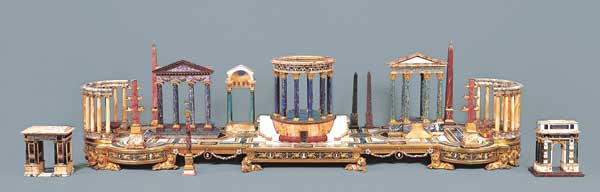
Perhaps I do not know enough about the history of desserts and their presentation in royal courts, but this remarkable piece (also part of the Charles IV exhibition) was, in fact, a dessert service made of gilded bronze, hard stones, ivory, wood, and enamels. As indicated by the name, desserts were arranged with precision on this service, forming an ornate presentation of cakes, pastries, and other edible delights for the King, the Royal family, and their guests-- talk about lavishness and luxuriousness! With or without desserts, this piece is remarkable and, despite my undeniable love of desserts, stands well on its own; the attention to and level of detail on this dessert service (not very noticeable in the image) is mind-blowing. The museum was so fortunate to have such an impressive exhibition, and I know that those who were made the trip in to view it were all but disappointed. My family and I visited the exhibition in its final days, and even though I have been working at the museum the entire summer, the "wow" effect was still there. I was sad to see it go, but now it is time to make way for the upcoming exhibitions for the fall and spring for which I have been researching during my internship!

This is but a fraction of what I could say about my time at the museum this summer. My hours of reading books and typing summaries, walking to and from the library and wandering through the galleries have all shaped my present vision and understanding of Spanish art-- its details and intricacies, historical, religious, and political themes, and overall beauty.  The research I have done as a curatorial intern and the knowledge that the staff has passed on to me are invaluable, and I feel that I have changed not only as a student of art & architectural history but also as a culturally aware human being.

"Only through art can we emerge from ourselves and know what another person sees." -Marcel Proust

Wednesday, July 14, 2010

No. 18, A Philosophical Mission

This evening I found myself at Barnes & Noble, yet again, on a mission: a philosophical mission. While I have always admired philosophy from a safe distance, it was not until recently that I felt the urge to dive into this seemingly dangerous study of the fundamental nature of existence, reality, knowledge, and, of course, life.  Perhaps it is this blog that sparked this interest-- my attempt at seeing the world for its beauty, at appreciating and understanding what makes life, in my opinion, beautiful.

The "Philosophy" section was certainly a modest one; it consisted of two sections of the aisle, strategically--and almost ironically--placed within the "Religion," "New Age," and "Bibles" sections, which are located on the border of the children's area and the "grown-up-books."  It was obvious that the poor Philosophy section had been assigned to that area due to the sheer lack of activity in the area; I did not even know where the Philosophy section was, which should come as a shock to my family and friends who all know of the embarrassing amount of time I have spent in that store.  The aisle must have been overwhelmingly delighted to have a visitor, for the books I planned to purchase tauntingly hid themselves among the almost obnoxious number of copies of Aristotle and Machiavelli anthologies that lined the shelves with the occasional Foucault and Sartre that moaned for attention.  I was somewhat taken aback by titles such as True Blood and Philosophy, Seinfeld and Philosophy, and Mad Men and Philosophy. While I love all of these shows, I couldn't seem to understand their significance, nor could I envision anyone purchasing them for any reason other than a burning desire to add yet another item to their memorabilia.  This was not at all what I imagined when considering philosophical ideas... but then again, perhaps modern philosophy is a great deal more modern than I thought.

Sifting through the works on the shelves for a book by Alain de Botton always proves to be slightly more complicated than I expect; half the time he is listed under "D," the other half under "B," and then the "de" unfailingly causes further problems.  I wonder if this happens only in the United States, probably so. Nevertheless, I eventually found The Consolations of Philosophy, one of the two remaining reads by de Botton I had yet to purchase (the other being Status Anxiety).  Who better to turn to in my discovery and journey through philosophy than a writer I so greatly admire.  Only forty-two pages into the book and I already know it will be as great of a triumph as How Proust Can Change Your Life, which you know, from an earlier entry, has certainly changed my life, igniting a respect and passion for Marcel Proust that has served me well during these difficult weeks since my grandfather's death. De Botton utilizes the teachings of Socrates, Epicurus, Seneca the Younger, Michel de Montaigne, Arthur Schopenhauer, and Friedrich Nietzsche in order to guide the reader through "our most common problems."  Although I am familiar with these philosophers from the literature and history courses I have taken over the years, as a newcomer to philosophy, I have approached this book--as well as this study--with an open mind and the desire to start afresh, prepared to soak in the thoughts that are presented to me.
(Aside from philosophy, however, I truly must recommend any and every book written by the great Alain de Botton. I have now read all of his works with the exception of Status Anxiety and, though I am working on it, The Consolations of Philosophy, and I can honestly say that no one has challenged me--let alone inspired me--to see things from a different perspective quite like Alain de Botton.  De Botton presents his thoughts in such a special, lucid, and intelligent manner, making every book a fantastic and moving experience.)

It was hard to believe that The History of Western Philosophy (originally, A History of Western Philosophy) by Bertrand Russell was so difficult to find. Perhaps it was the summary located on the book's spine that threw me off-- how strange! Though I certainly have the desire to work my way through this immense oeuvre, I hope to have the necessary motivation to complete it after enjoying de Botton's modest and accessible interpretation of philosophy.  This collection of philosophical thought is, in a word, intimidating, totaling in 836 imageless pages. "What exactly is the reason behind his purchase?" one might ask. Well, in discovering the joint program between Paris 1 Panthéon-Sorbonne and Paris 3 La Sorbonne Nouvelle in Philosophy with a track in Lettres Modernes, I found the seemingly perfect opportunity to begin to enrich my comprehension and appreciation of philosophy in the most perfect of settings. I became resolved to participate in this program while still quenching my thirst for art and architectural history courses as well as one or two cinema courses. Why not try something different? How could I possibly resist adding another passion to my life? And even if it does not turn out to be what I expect, there is a lesson to be learned from that experience as well, for, as Proust once said, "We do not receive wisdom; we must discover it for ourselves after a journey that no one can take for us or spare us."

Saturday, July 10, 2010

No. 17, Interlude

I have reached the interlude of my summer.  These past seven (almost eight) weeks have been quite the whirlwind-- or at least in comparison to what I am accustomed to in regards to summer vacation.  Between my summer internship, biology course, "light" reading, blogging, and the untimely death of my grandfather, it is hard to believe that so much has happened in such a fairly short amount of time.  I have a feeling that this next half of the summer might be less... chaotic? Yet I know that the final weeks before my departure for Paris will surely be pandemonium-- packing a year's worth of everything and preparing on an emotional and mental level.

It's hard to imagine what life will be like seven weeks and two days from now-- the day I exchange Dallas, Texas for Paris, France.  I would be fooling myself if I planned on it being completely different. I'll wake up and most likely feel as if I am embarking on any ordinary trip, gather my last minute items (contacts, glasses, toothbrush, laptop, and, impulsively, a book I probably will never end up reading).  I'll load my bags into the car and hop in myself, anticipating the numerous times my mother will turn to ask me, "are you sure you have your passport? Your plane ticket? Everything?" I'll answer "yes," slightly more irritated each time, and as DFW-Airport comes into sight, a gaping hole will produce itself in the pit of my stomach, and I will immediately regret my decision-- a side-effect of overexcitement trying to trick me out of my dream. Before exiting the car, I will take a deep breath, observe the meaningless parking lot and then the driver's seat where my mom will be seated about to ask me, "you ready?" or "are you going to be okay?" Or both. I will then start to cry, if I hadn't already, and as I unload my bags and approach the security line, my mom and I will reassure me that everything will be fine, that I am ready, that I never wanted anything more than I want this.  And then I will go.

Only time will tell if I have envisioned this spot-on. Imagining my life in a different setting--both physical and mental--is almost impossible for me. I think of only the more "glamorous" moments rather than taking a more realistic approach. I know very well that this experience will throw some curved balls at me, but I also know that I am not alone in the desire to ignore this fact, this undeniable truth.  I will miss my home, my family and friends, and, probably most of all, I will miss my sister.  Yes, my sister is family, of course, but she is really something so much more. Though only four and a half years apart, I often joke that we were meant to be twins, only she wasn't quite ready yet.  I like to think that she knows how important she is to me, but perhaps she does not. So incase you ever second-guess it, Mowmao, you are my true best friend.

Why am I reflecting now, so far in advance?  Probably because this has been my first chance since arriving home from school that I have had the chance to think without the pressure of other things needing to be done, needing my attention. I think of Paris, France, and Europe every single day, yet I have failed to consider all that I will leave behind thoroughly.

Who will I be a year from now? Six months from now? Two months from now? That person is in the making and is only to be bettered, more colorful, more passionate, more reflective.  New experiences bring on new facets, new features for one's personality and character, and oftentimes, these details are visible to others and, especially, to oneself. If there is one thing I anticipate most about this experience, it is not the guaranteed improvement of my French, nor is it the classes I will take, the friends I will make, or the new places I will visit.  It is the way in which, as a result of all of these minor ingredients in my journey, I will see the world-- the way I will embrace life through my more developed and more seasoned eyes.  For as my beloved Marcel Proust said, "The real voyage of discovery consists not in seeking new landscapes, but in having new eyes."

Sunday, July 4, 2010

No. 16, Proust Questionnaire


Several times in his life, Marcel Proust responded to an English-language questionnaire (now called the Proust Questionnaire), of which the answers were compiled into manuscripts.

 Proust's responses were just as personal and intimate as they were meaningful.  Whether or not he aimed to be profound or merely honest, I do not know.  I assume that he had no intention of publishing the questionnaires, for Proust was not one to be arrogant, conceded, or self-absorbed.  Whatever the circumstances, I find the questionnaire to be a valuable peek into Proust's mind, which was as playful as it was straightforward.

One question asks for one's favorite occupation, to which Proust responded, "Loving."  Another demanded one's idea of misery-- "Not to have known my mother or my grandmother."  Favorite Bird: "the Swallow." Hero in fiction: "Hamlet."  A favorite of mine is his answer to "the natural talent I would like to have: "will-power and irresistible charm."  Perhaps it is because I view and adore Proust for the profundity of his thoughts and written word that I find this response so surprisingly unlike Proust; yet that does not make me love it any less-- quite the contrary, in fact.

However, there are two responses that I most greatly admire, both of which has become very important to me since I first heard of and read the questionnaire:

1. The country where I should like to live: "One where certain things that I want would be realized, and where tenderness would always be reciprocated."
 2. How I wish to die: "A better man that I am, and much beloved."

Yes, I love France a seemingly impossible amount.  And yes, I plan to live there this year and, most likely, at least another year if I am accepted for the assistantship program upon graduating from university. Do I want to live there for the rest of my life?  That I do not know.  While tenderness may not always be reciprocated--for that seems too perfect to be true--France is, for me, a country that is magical, where any dream seems attainable; there is some sort of mysterious power that takes over me when I see Notre-Dame de Paris, a terraced café, or just a mere librairie.  It is dazzling, mystifying, and vivifying, much like a fairy tale.  I know that life is not perfect and that life in France will not attain perfection, but the journey toward this "ideal life" is best traveled with an open mind and open heart and by approaching each day and each experience with the same amount of wonder and excitement as the last.  To realize anything that I desire. To keep the magic alive.

Just one week ago today, I was at my grandfather's funeral.  I have yet to fully accept the reality of his death.  His health had been poor and further deteriorating the last years of his life, and an injury he suffered during the Holocaust served as a constant reminder of the pain he would have to endure--both physically and mentally--throughout his life.  Even still, he provided the best life possible for his wife, his three children, and his six grandchildren while also giving back to the community and building a multitude of business relationships and friendships.  He improved his quality of life through his motivation, dedication, and sheer desire to live upon arriving in the United States in 1948.  Through his successes and his family, he improved both his image to others and his spirit within himself, which was surely a hard task after experiencing the atrocities he faced as a young man.  To say that he died loved would be an understatement to the greatest degree.  At his funeral, there was hardly any remaining standing room; the chapel was filled to capacity with people who loved, admired, and cherished my grandfather-- young and old, family and friends, acquaintances and life-long companions.  I think Proust might have admired my grandfather, but in any case, I certainly do.  Like Proust and after reflecting on the life of my grandfather, I, too, hope to die improved and loved, or even just loved, for nothing could be more important than feeling valued and cherished by others, especially those that I myself value and cherish.  But aside from death, I want to live loved for a long, long time.

Perhaps it was simply Proust's boredom that inspired him to respond to the questionnaire at certain intervals in his life.  Yet I would like to believe that he answered the questions with the intentions of "monitoring" his personal growth-- the ways in which his views would change at various points in his life-- and, furthermore, as a way to reflect on what motivated these transformations.  I believe that it is important to take a step back from time to time and view ourselves from a different angle, a varied perspective; it might inspire oneself to travel in a different direction, to change our ways, or even confirm the accuracy of the path one is currently taking.

The first item on the questionnaire asks for one's "most marked characteristic."  While Proust's response is surely personal, I feel his reply is not only honest and sincere but also the response we would all give if we were not quite as ashamed or embarrassed to admit its truth, for we all have: "A craving to be loved, or, to be more precise, to be caressed and spoiled rather than to be admired."

Monday, June 28, 2010

No. 15, Bloom

As many who are close to me know, my maternal grandfather, who I refer to as my Popi, passed away this past Thursday, June 24, 2010.  While his health had been deteriorating for quite some time, such does not change the fact that his death was not only untimely but also painful.  Words cannot even begin to express how much my Popi means to me and, furthermore, how grateful I am for all that he has done for me in my life.  He personifies the ideal man-- the perfect representation of all that is good and beautiful in the world.  As a survivor of the Holocaust, it would be an understatement to say that he suffered the greatest atrocity known to mankind.  Yet more importantly than surviving such a horror, my Popi continued to live, to strive for greatness, to achieve his dreams and a better life.  He is an inspiration to us all.

This was my first true experience with death.  I have never had a family member pass away at an age when I could properly comprehend as well as feel the burden and sorrow of the situation.  It is almost surreal, yet in the worst way possible.  I have yet to fully accept the situation; it is so hard to believe that he is physically gone.  However, perhaps his absence is so difficult to believe because of his strong presence in my heart and soul, because of the fond memories I carry of the times we had spent together.  Such recollections make him immortal, not only for me but also for my entire family who collectively share the weight of his passing.  Popi will always be missed, eternally remembered, forever cherished.

Here is the eulogy I shared yesterday morning at his funeral:

Thank you all so much for being here today for me, my family, and my Popi.


Marcel Proust, a French novelist, once wrote: "Let us be grateful to people who make us happy; they are the charming gardeners who make our souls blossom."  My Popi was one of these charming gardeners, who with his hands and heart shaped our world and our souls in which he lives eternally. I can say without hesitation that I am grateful not only for all that Popi has ever done for me but also for being so blessed to have him as a part of my life.


My Popi was and will always be a source of happiness; his kindness, laughter, and generosity humbly reflected the mensch he exemplified throughout his life. He often reminded me that I should strive for success, but, most importantly, that I should be happy with and passionate for what I do, who I love, and who I am.


For me, my Popi is a flawless representation of mental and emotional strength; after all that he had suffered and experienced, he chose to rise above and embodied grace, warmth, and sagacity-- all qualities that I feel have been passed on to me by example.


So let us all be grateful to my Popi and always remember him for the happiness he has inspired within us all and for making our lives thrive and bloom into brilliant gardens of love, spirit, and radiance.


Popi
September 22, 1922 - June 24, 2010

Thursday, June 24, 2010

No. 14, "Partons Vite"

Un petit post sur la musique.


Few things frustrate me more than restlessness.  When I find myself in such a state, I often pull my current read out from under my pillow where it is placed for safekeeping while I dream at night.  Tonight, however, I am far too mentally exhausted to comprehend or extract meaning from the written word.  I choose music. Finding a song at a late hour has always been a daunting task: choose one too exciting and one might inadvertently preserve the agitated state; choose one too boring and one will most likely transfer one's concentration and anticipation to the awaited ending of the song rather than the real task at hand, sleep.


Listening to Joshua Radin at night has produced varied results.  Oftentimes, I will drift off into romantic imaginings of a far-fetched love affair, or even friendship, with the troubadour who essentially embodies my vision of the perfect man. I have a 50/50 chance of either slipping into a deeper state of delusion, a slumber cushioned by the gentle tones of his voice in the distance, or simply letting my imagination run wild with such fantasies-- as pathetic and excessive they may be. One of the songs released on his latest EP, "Streetlight," is so beautiful--like all of his ballads--that I have set a limit to the number of times I can listen to it on a given day.  After twenty years, it seems that I still haven't quite achieved an effective way of curbing my obsessive compulsions. I still maintain that there is nothing wrong with passion.

Feist is normally the perfect solution-- the perfect mixture of soothing beats and softly woven words to encourage my mind to surrender to the heaviness of my eyelids, i.e.  "Gatekeeper," "The Limit to Your Love," and, my personal favorite, "So Sorry." Her voice is hauntingly beautiful, and the fluidity of the tracks in her albums makes it easy to fall under her spell whether wide awake or dozing off. Yet, to my dismay, Feist's ballads and melodies have lost their effect in inducing sleep; my mind has mastered its predicability and, for once, has discovered that familiarity has its disadvantages.

In short, I have been in need of a new song to lead me into a state of reverie that consequently ushers me into "dreamland." And to my surprise, this evening I found such a tune.  Oddly enough, I do not even remember purchasing it, nor do I remember it being offered to me as a casual recommendation.  Yet as I was skimming my iTunes library just thirty minutes ago, I came across "Partons Vite" by Kaolin, a French rock band. The lyrics are simple yet moving, and the melody is simultaneously catchy and calming. Wherever it came from, I am glad it settled in my collection, for it is certainly here to stay.

I will end this unusually brief post with the lyrics and a recommendation of my own: give it a listen.

Allez danse, danse, vient dans mes bras,
Allez tourne, tourne, reste avec moi,
Allez partons vite si tu veux bien, dès le jour,
Le soleil brille très haut tu sais,
Mais j'aime ça, je t'attendais
Alors partons vite si tu veux bien, sans retour...

Rit plus fort et parle-moi
De nos projets, de nos rêves tout ça
Donne-moi la main, embrasse-moi, mon amour
Le temps comme ami, moi je veux bien
Mais les amis ça va, ça vient,
Alors partons vite brûler le jour et la nuit

Evidemment, tu l'aimes encore,
Je le vois bien tu sais, et puis alors?
Mais pour l'instant ferme tes yeux, passe ta main dans mes cheveux.

Je veux entendre, ton coeur qui bat, tu sais, je crois qu'il chante pour moi
Mais en douceur comme ça tout bas, comme un sourd
Mon coeur lui s'emballe, il vole haut, peut être un peut trop haut pour moi
Mais je m'en fou, je suis vivant pour de bon

Allez danse, danse, regarde-moi
Allez tourne, tourne, ne t'arrête pas
Allez partons vite, si tu veux bien, dès le jour
Le soleil brille, profitons-en
Je t'attendrai, je t'aime tant
Alors vas-t'en vite si tu veux bien, sans retour

Evidemment, tu l'aimes encore,
Ça crève les yeux mon dieu, tu l'aimes encore
Mais pour l'instant ferme tes yeux, passe ta main dans mes cheveux

Allez danse mon amour! Allez danse!
Faisons de nos enfants des droits!
Fait tourner le monde mon amour, fait tourner le monde

Allez danse, danse, retourne-toi
Allez tourne, tourne, ne t'arrête pas
Allez partons vite, si tu veux bien, dès le jour
J'ai manqué d'air je m'en souviens,
Toutes ses années sans toi sans rien
Même mes chansons se baladaient le coeur lourd

Evidemment, tu l'aimes encore,
Ça crève les yeux mon dieu, ça crève les yeux mon dieu
Mon dieu...

Friday, June 18, 2010

No. 13, La Richesse du Monde: Architecture

Architecture is formally defined as the art or practice of designing and constructing buildings.  In my opinion, the discipline can be more intimately described as an interpretation, an image, a mode of expression, for architecture is—above all things—a reflection of the architect and the setting—both the location and the era.  Oftentimes, when viewing a structure, we do not go past its aesthetics, its visual appeal, and, in doing so, we sacrifice the deeper understanding and appreciation we could obtain by choosing to delve deeper into the building’s history and value to society.  Of course this does not mean that one should ignore the explicit beauty of a site; I, for one, am often guilty of basing my judgment on such qualities.  However, after detecting such allure and elegance, I would like to suggest that one should take this recognition a step further by asking oneself, “why do I find this beautiful?  In studying and exploring architecture—as well as film, art, music, etc—we owe it to ourselves—as well as the architects, directors, artists, and musicians—to sincerely analyze that which entices and intrigues us with the hope of grasping a more profound understanding of our passions and their value to our lives.

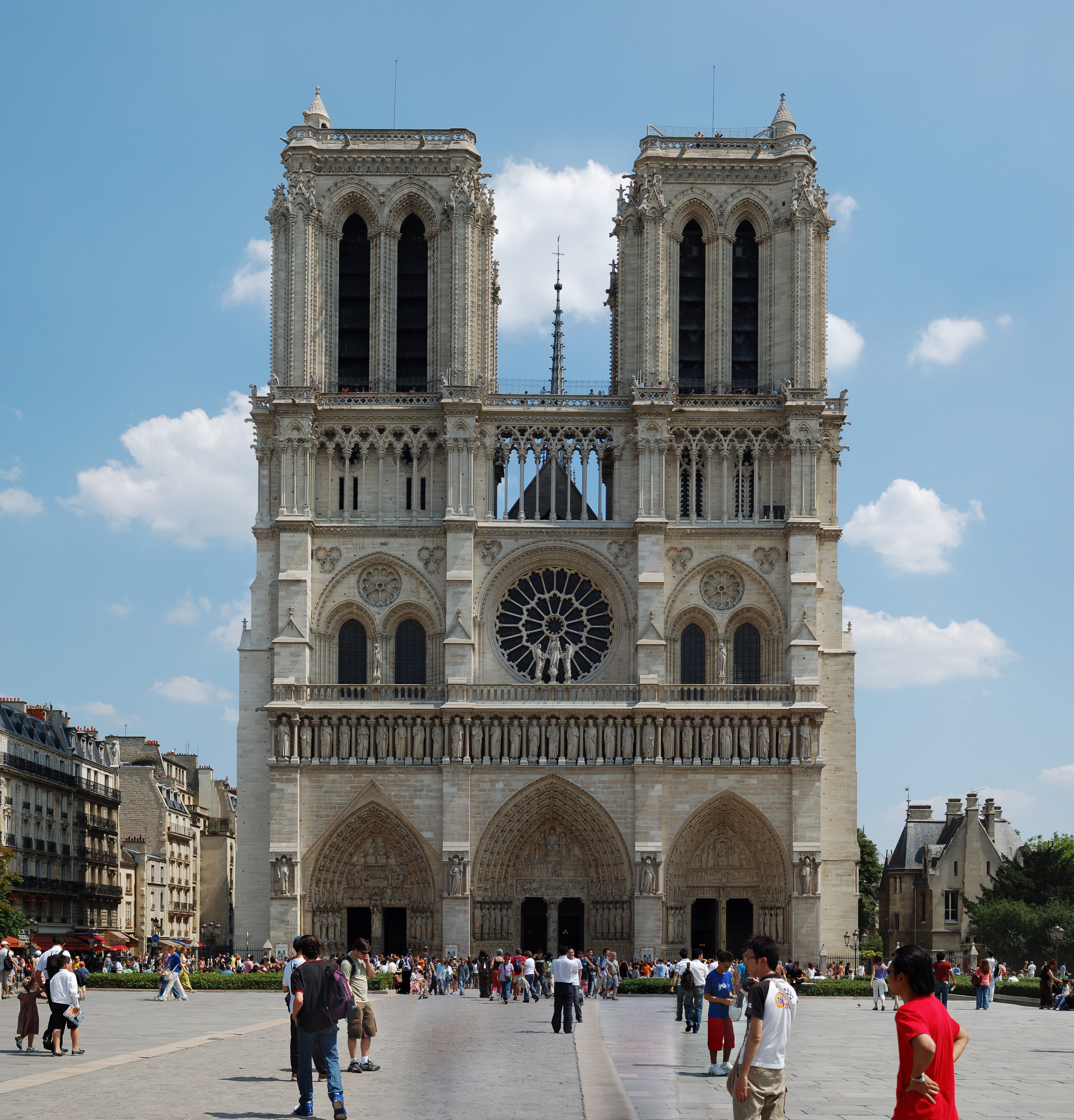
In the two years that I have formally studied architecture, I have soaked up what I believe to be a considerable amount of knowledge on architectural form and function.  Each building and architect offers its own unique agenda, providing a distinctive design and a discrete human experience.  The “human experience” is just as much what we get out of our visit to a building as the intentions of the architect through the supplied human factors of the structure.  For example, one might ask, “when visiting Notre-Dame de Paris, how can one avoid the feeling of being dwarfed by the scale of the cathedral?  Being “dominated” by Notre-Dame is as important as being embraced by the cathedral.  One can tell immediately by the size of the three entry portals that the space in which he or she is about to enter will be one of immense and impressive size and scale—no doubt about it.  Such conclusions are confirmed after accessing the interior, where one finds himself amid sky-high vaulted ceilings, colossal chandeliers, majestic stained-glass windows, and columns of a thickness similar to that of a Redwood tree.  It is true that if the exploration of this national treasure ends here, in the areas of the nave and sanctuary, one could easily assume that the cathedral’s primary goal—other than religious inspiration and international acclaim—was to diminish the value of the intimacy of the religious experience.  This is, in fact, a valid thought. The religious experience Notre-Dame de Paris was aiming for was one that emphasized the unity of a congregation through devotion to G-d rather than that of a personal bond. The simplicity of the individual wooden chairs that make of the pews of the nave assert the desire for the congregants attention to be directed towards the grandeur and unrivaled splendor of the cathedral, an example of elegance and glory that could be outmatched only by the Supreme Power.

During my last trip to Paris in late July 2009, I was resolved to visit Notre-Dame de Paris, despite the tourist trap, and, furthermore, to brave the climb to the top.  After entering the cathedral, my group of twenty-or-so visitors was ushered into the gift shop before the trip up.  Ready for our climb, we began the trek, greeting each of the 387 steps with exaggerated breathing.  While it was not a difficult climb per se, the 387 steps were arranged in a continuous, tight spiral—similar to those at the Arc de Triomphe—throwing me slightly off-balance from time to time and forcing me to take a break every now and then.  This climb put new meaning in “communal experience” as I found that I was not the only one suffering from periodic dizzy spells.  However, the staircase was only wide enough for one person; thus, before being used for “the Tower tour,” the climb was a chiefly individual—and seemingly never-ending—experience, almost simulating the ascension to the heavens.

Upon arriving at the top, the “observation deck” and pathways between the towers further insist the experience on a personal level.  Aside from the impressive size of the bells and the statues of the twelve apostles that decorate the spire, one is able to interact with the gargoyles, disturbing as they may be, and appreciate the detail of the cathedral’s construction.  Yet, this sort of appreciation differs from that inspired by the cathedral’s interior, for here, atop the famous structure, one can interact with the design, feel the materials, view the ornamentation under natural light and without the grand distraction of the gorgeous stained-glass, exquisite paintings, and stunning organs.  From this viewpoint—both physical and mental—the experience becomes less religious and more focused on spotlighting the home of the cathedral, Paris, providing panoramas that, in my opinion, surpass those offered by the Tour Eiffel.  To some, such an outlook may, again, dwarf the viewer, forcing him or her to feel almost microscopic within the density and monumentality of Paris.  However, I seized this moment; while standing atop one of the most famous and most beautiful cathedrals in the world, I saw Paris from a height where I could distinguish one area from another, pick out a bookstore I had perused while also note Sacre-Coeur, Montparnasse, and La Défense with a very slight turn of my head. Standing alone and far away from the hoards of tourists, I soaked in the intentions of the original anonymous builder, Pierre de Montreuil, and, later, Eugène Viollet-le-Duc (among others) in shaping their desired “human experience.” I felt, in my moment, a sort of confirmation of my presence in Paris; I knew exactly where I was and what, one day, I could be a part of—a city that simultaneously inspired and comforted me despite the almost 5,000-mile distance from home. While there are plenty of places one can escape to in Paris, few astound and take one aback like Notre-Dame with its periodic moments of intimacy amid such glory and resplendence.


During the 384 steps back down to ground level, I sensed a gradual return to reality, a gravitational pull towards the world of which I was a part, like a unit that would re-establish the balance that had been altered during my ascension.  I arrived at the bottom and, as I exited, I greeted the façade of Notre-Dame once again, confirming my achieved understanding of not only the cathedral’s inspiration to artists, writers, and architects but also, then more than ever, the power of architecture.

Sunday, June 13, 2010

No. 12, Anticipation

It is hard to believe that in less than three months I will be leaving for my year-long stay in Paris and embarking on a journey--both physical and mental--that is sure to change me as a person.  Aside from time itself, all that stands in my way is: the purchase of an airline ticket, the finalization of the visa process, and the completion of my two online biology courses.

Anticipating my year abroad, I cannot help but think back on my first experience leaving home.  As you all know by now, this great step was not taken until the summer before my senior year of high school-- a bit late in comparison to my other friends who had braved sleep-away camp summer after summer.  Overwhelmed with excitement and exhilaration, I failed to acknowledge my fear and anxiety, assuring myself that I was sufficiently both mature and prepared.

A few days before departing, my mother and I met my French teacher--more accurately, mentor and inspiration-- for a café to discuss my upcoming experience and share last minute advice.  Mr. Azzi warned me about my French-size room and the inevitable struggle of speaking French "under pressure"-- prompting the fear of being dependent on a language other than my mother tongue.  "You should expect, when you arrive, that you will be upset, probably cry, and be very homesick.  Just know that this is just the jet-lag and that upon waking up the next morning, you will regret feeling the way you did the day before-- I promise."  I shrugged off Mr. Azzi's advice saying, "I am too excited for that to happen!"  But of course, Mr. Azzi knew all too well that I was only fooling myself.

 Upon arriving in Nice, I was certainly tired, yet I was immediately energized by the breathtaking panoramas of the city spotlighted by the windows of the autobus.  We arrived at our lycée, Lycée Masséna, and as I stood in the check-in line, I began to feel the first signs over overwhelming fatigue, which I boldly fought through the three-story climb to my room whilst carrying two overfilled duffle bags.  I found my room and nudged open the door only to find that my room was more than twice as bare and tiny as I had imagined.  I proceeded to break down.  I phoned my mother bawling, begging to come home, and insisting that I was assigned to the worst living situation possible.  Naturally, my mother was beside herself; not knowing what to do or how to help, she consoled me as best she could reminding me of how long I had been looking forward to this experience and pleading that I give it a chance.  I hung up the phone and rushed to dinner so that I could return to my prison cell as soon as possible.  I spoke to a few people who seemed to be far less upset than I was; yet I sulked back to my room still longing to return home to my comfort zone.

I opened my window to find a quaint view of Nice-- my school, some picturesque houses, and a lush landscape of deep greens and blues.  It was quite stunning, and I began to feel a bit of comfort in this foreign setting.  A few minutes later, my portable rang, flashing a number I did not recognize.  I picked up the phone with a shy "allo?" and, to my surprise, I heard a familiar voice on the other end: "Lisa? This is Mr. Azzi. You didn't believe me, did you?"  My fear and sadness turned to anger, and I began to shout at and complain to Mr. Azzi, cursing him for "forcing" me into such an experience-- essentially telling him that I hated him and blaming my emotions solely on him.  "Your mom called me freaking out, saying that you wanted to come home and hated everything... so I told her I'd take care of it."  I told him that he was not mistaken.  Yet after a brief conversation and some words of encouragement, Mr. Azzi had said enough to calm me down and to make me agree to going to sleep and starting anew tomorrow.

Just as Mr. Azzi had promised, I woke up the next morning refreshed, reinvigorated, and ready to embark on my six-week adventure along the Côte d'Azur.  I could vaguely recall the tears and howls I released the night before, and I was thoroughly ashamed of myself.  How could I so prematurely and cruelly reject the beauty and splendor of Nice?  Such blasphemy compelled me to immerse myself in French language and culture even more than I had originally planned.  I breathed in the scent of the Mediterranean, imbibed a delectable diabolo fraise, sampled the life-changing ice cream of Fenocchio, and confidently conversed in French with anyone who was willing to embrace my frequent mistakes.  I met some amazing people, greatly improved my oral and written French, and developed as an individual more than I could have ever imagined.  One could say that I was "sold" after this experience; I knew I would go on to major in French and, one day, be a French professor.  I am proud to say that I am still on this journey and am still as passionately determined to follow through with this aspiration.

This time around, I anticipate the fear I will experience upon arriving in Paris and the desire I will feel to return home every now and then.  I hope that going into this experience with this understanding and acceptance will ease the transition into this new chapter of my life.  Ever since I returned home from Nice in August 2007 and, more recently, from Paris in August 2009, I have been anxiously awaiting this year abroad.  I have never been so excited about or scared of anything-- feelings I have come to understand and consider as healthy and essential to the human experience (or at least to my own).  If a year in Paris opens my eyes and emotionally shapes me even half as much as Nice did in only six weeks, I think I can safely say that I expect to truly find myself and the person I hope to be in the future-- a revelation to which I wholeheartedly look forward.

Monday, June 7, 2010

No. 11, "How Proust Can Change Your Life"

Last year for my birthday, my best friend Juliette presented me with a book titled The Architecture of Happiness, the second non-fiction work written by Swiss writer, Alain de Botton.  Whether or not Juliette was aware of its literary success, The Architecture of Happiness was the perfect gift for me as an architecture admirer and literary devotee.  The book discusses the way in which architecture and its beauty affect us and our well-being-- both as individuals and as a society.  In my architecture courses, I have always been concerned with this concept: the role of architecture and the built environment in shaping an identity.  While conducting research on the architectural designs of Paris and Algiers under the reign of Napoléon III, I aimed to prove that the reformations of these cities solidified the desired identity of the French empire as well as the intentions of Napoléon III as an emperor.  In The Architecture of Happiness, Alain de Botton validates the power of architecture, yet he presents his argument with such poise and graciousness, which, in my opinion, writers often lack.  After reading this book, I felt the sense of general contentment for which Botton had clearly aimed, almost as if he had authenticated my own views of architecture and its potency that is somewhat unacknowledged by the common man.  I imagine that I would have eventually purchased this book somewhere down the line, but I am truly grateful that Juliette expedited this acquisition.

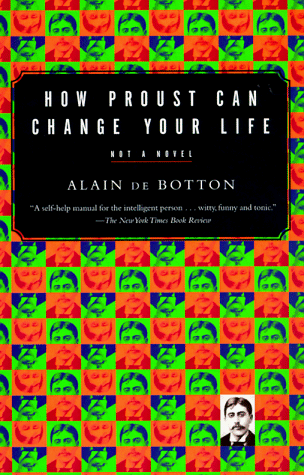
Alain de Botton's first non-fiction work is titled How Proust Can Change Your Life. This book has been on my reading list even since I completed The Architecture of Happiness, yet it had remained overlooked until this past Thursday evening when I found myself at Barnes & Noble while browsing the "Essays" section.  Just two shelves above literary luminary, David Sedaris, I saw the all-too familiar cover of The Architecture of Happiness beside How Proust Can Change Your Life, a funny-looking paperback with green- and orange-tiled images of Marcel Proust, a renowned French novelist and essayist.  This welcomed confrontation forced me into purchased the book, which I eagerly began upon returning home.

In How Proust Can Change Your Life, Alain de Botton addresses Marcel Proust--both his works and his life-- in a way that provides both reflections on the writer as well as offers advice and "self-help" based on de Botton's thoughts on Proust and his value to everyday life.  I guess the title should have given away its "self-help" agenda, yet, halfway through the book, I have found myself as enveloped in de Botton's words as the plot of any fiction piece, hanging on his every word and devouring the quotations provided from Proust's works and critiques.

Marcel Proust (or, Valentin Louis Georges Eugène Marcel Proust) is best known for his seven-part semi-biographical oeuvre À la recherche du temps perdu (In Search of Lost Time), which totals in 3,200 pages-- of which I have only read several excerpts.  This project began in 1909 and ended with Proust's death at the age of fifty-one in 1922.  Proust is described as a man who lived for detail, valuing the minutia to be equal, if not more precious, than the "plot-summary" points.  In the chapter of How Proust Can Change Your Life that is appropriately titled "How to Take Your Time," de Botton discusses Proust's conflict with reading the newspaper-- more specifically, the "news-in-brief" section-- for he felt that condensing a story to such a great degree undermined and damaged its events and their importance, compelling Proust to imagine the "bigger picture" for himself--however accurate or faulty it would be.  De Botton writes, "it shows how vulnerable much of human experience is to abbreviation, how easily it can be stripped of the more obvious signposts by which we guide ourselves when ascribing importance."  I find this so profound-- probably because it is true.

Clearly the length of Proust's works boldly represent the extreme opposite on this spectrum of detail, a quality that both deterred (and still deters) readers as well as induced praise from critics who cited Proust as a "literary genius."  While I myself have not braved the immensity of À la recherche du temps perdu, I hope to do so one day.  Nevertheless, I do value Proust's strive to spotlight and emphasize the significance of small details and trivialities, from the annoyance of restlessness to the particularities of one's morning routine.  After all, these aspects shape us-- our identities.  Although whether we comb our hair before brushing our teeth (or vice versa) may not share any insight on our value as human beings, it certainly reveals how one person is different from the next in an infinite number of ways.  These minor distinctions and variations remind us of how beautiful we are in our own respective ways and should, hopefully, make us step back and recognize the grace and wonder we can find in one another.

De Botton, Alain. How Proust Can Change Your Life. New York: Vintage International, 1997.

Thursday, June 3, 2010

No. 10, "Fenocchio"

As I have been preparing for my year in Paris, I have also been reflecting on the times I have spent in France in my recent past.  I can go on for hours talking about the architecture of France and the multitude of cathedrals and museums I have visited out of personal interest.  However, for those who are neither francophiles nor architecture enthusiasts, I find it difficult to engage my listener, who often struggles to connect to my passions although he or she certainly acknowledges my enthusiasm.  Can one truly do Notre-Dame de Paris justice when describing the cathedral to one who has never seen its grandeur?  Can one successfully capture the feeling of wandering through the streets of Paris and translate such an experience into something that resembles a "five-minute pitch?"  I say no, especially considering the profusion of books written on just these two subjects.  Yet, I have found that every listener can be easily captivated by a certain subject, one that anyone and everyone can relate to: ice cream.

Aside from those that are lactose intolerant (though I am certain they dream of ice cream just as much--if not more--than everyone else), who doesn't love ice cream?  Looking back on my childhood, many of my fondest memories involve ice cream; all birthdays are honored with an ice-cream cake, and "chinny" (the name I assigned ice cream as a toddler) is used to celebrate successes and awards as well as rectify upsets and misfortunes.  But, of course, ice cream also fills the in-betweens of my life (and that of my mother and sister), giving it a sort of magical power to improve or enhance any and every situation.

I made my first extended journey away from home in the summer of 2007 when I participated in a language immersion program in Nice, France.  It was a big step for me, and made my commitment to French clear to my friends and family-- an allegiance that still holds strong.  While the separation from ice cream for the summer was certainly not a big issue, as a family tradition, it was hard to put in perspective what it would be like to leave everything behind.  All my friends had gone to sleep-away camp from a young age, but I never had such an experience, so as a seventeen year-old girl, it was a strange concept to wrap my brain around.


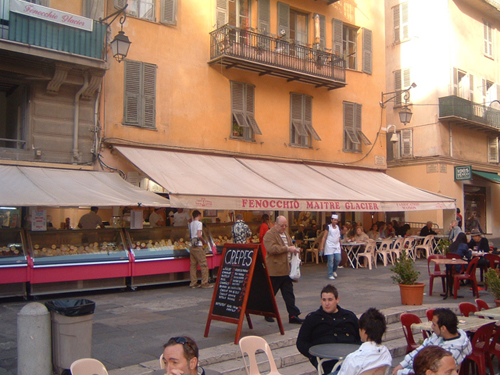
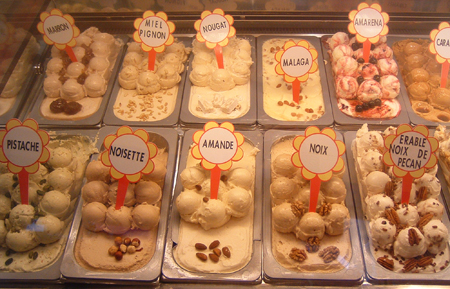
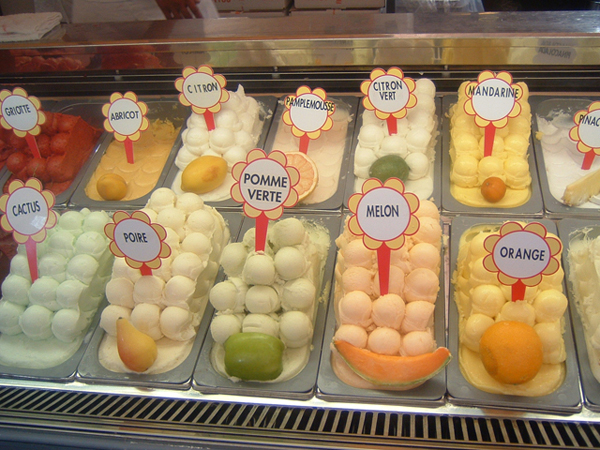
Shortly after arriving in Nice, I made my first pilgrimage to Fenocchio, a glacier (or, ice cream shop) in the Old City of Nice-- Place Rossetti, to be exact.  This visit was the beginning of a love affair.  From the  59 ice creams and 35 sorbets-- totaling in 94 flavors--I chose Ferrero Rocher and Nutella as my first gift to my taste buds, which were completely and utterly satisfied.  During my five weeks in Nice, I frequented Fenocchio at least once a day and defended my visits by the size of the scoops, or boules, and the opportunity it gave me to practice my French-- so witty, I know.  I am almost positive that I sampled every flavor by the time my séjour in Nice had come to a close (except for banane, chewing-gum, and bière).  If I had to name my top five favorites, I would choose: Ferrero Rocher, Nutella, Noisette, Pistache, and Fruit de Passion... but then I would have to mention Café, Poire, Pèche, Fraise Tagada, and Framboise.  Honestly, you can't go wrong.


When it was time to return to Texas, I was sad to leave my friends, la France, and, bien sûrFenocchio, a place that I continue to dream about until this day and often speak about with friends and family-- all of whom are anxious to visit this glacier that I have made out to be some sort of "heaven," which it most certainly is.  Even though I resumed my traditional trips to Baskin Robbins with little hesitation, I always remind myself of the happiness I found in the tiny boules de glace and the moments de bonheur at Fenocchio, and I anxiously await my return to Nice at some point during this coming year where I plan to relive this life-altering experience that ultimately contributed to the richesse de mon monde.

Sunday, May 30, 2010

No. 9, La Richesse du Monde: Film

Film, like art, is yet another way to capture the emotion and imagination of the screenwriter, director, actors, and all who are involved in the creation of the project.  I find it immensely important not only to my life on a personal level but also to la richesse du monde, for it manifests the progress, creativity, and determination of humankind.  The final product acts as a direct contribution to society with the additional desire to entertain, educate, and/or enchant its viewers.

My love for film is one of the constants in my life.  About four years ago, I began collecting French films and have been slowly adding to my collection ever since.  I adore The Criterion Collection despite the high prices, for the bonus features are generous and often include conversations with the director, actors, storyboards, etc.  Film has the unique ability to have a profound influence on one's views of life and the world as well as conjure up feelings of nostalgia, happiness, and sadness with little effort.  These are the ways by which consider my favorite films-- their meaning(s) and their effect(s).  In building a list of my favorite films, I originally aimed for five, which turned into ten, which ultimately turned into fifteen.  I could easily continue on to thirty or perhaps fifty, but I feel that these fifteen effectively capture the value of film in my life.  However, I will only elaborate on my top five for the sake of the reader, especially considering the endless amount of praise I can give for each of these phenomenal films.


1. The English Patient (1996)


It is with no hesitation that I rank "The English Patient" as my all-time favorite film.  While it is neither a revolutionary film in the history of cinema nor ranked on the AFI Top 100 Film list, "The English Patient" is the most poignant, romantic, and epic film I have ever seen-- and, most likely, will ever see.  The story begins with a man who, while flying a plane in the Egyptian desert, is shot down by Nazis and, consequently, critically burned. Initially known as "the English patient," the man is under the care of Hana (Juliette Binoche) in an abandoned monastery in Italy just before the surrender of the Germans in World War II.  Over the course of the film, the man experiences a series of flashbacks of his life before the accident, gradually shedding light on his identity, which he himself can no longer recall.  The viewer learns the patient is Count László de Almásy (Ralph Fiennes), and the flashbacks illustrate his passionate affair with Katharine Clifton (Kristin Scott Thomas).  The film also follows the nurse, Hana, and her relationship with Kip (Naveen Andrews), an Indian sapper who defuses bombs for the British Army.  "The English Patient" also features Willem Dafoe as David Carvaggio, whose fate depended on the actions of Almásy, as well as Colin Firth as Geoffrey Clifton, Katharine's husband.  Based on the novel by Michael Ondaatje, director Anthony Mingella's visually stunning interpretation of "The English Patient" went on to win nine Academy Awards, including Best Picture.  The score, written by Gabriel Yared, is flawless; the movie theme serves as an immediate reminder of the depth and passion of the film as depicted by the cast.  I admit that Ralph Fiennes, Kristin Scott Thomas, and Juliette Binoche made it on to my short list of favorite actors and actresses solely based on this film--though each of them have immensely impressive filmographies, i.e. "Schindler's List" (Fiennes), "Il y a longtemps que je t'aime" (Thomas), and "Les Amants du Pont-Neuf" (Binoche).
I remember being floored by the cinematography and the screenplay (which I own).  Every scene is lit perfectly, making the desert and a run-down monastery appear divine and surreal; every line is so intense and sincere.  At the end of the film, Hana reads a message that Katharine had written to Almásy, which happens to be one of my favorite quotes from the movie:


Katharine: "My darling, I'm waiting for you. How long is a day in the dark? Or a week? The fire is gone now, and I'm horribly cold. I really ought to drag myself outside-- but then there would be the sun. I'm afraid I waste the light on the paintings and o writing these words. We die, we die rich with lovers and tribes, tastes we have swallowed, bodies we've entered and swum up like rivers, fears we've hidden in like this wretched cave. I want all this marked on my body. We are the real countries are, not boundaries drawn on maps with the names of powerful men. I know you will come carry me out to the palace of winds. That's what I've wanted-- to walk in such a place with you, with friends, on an earth without maps. The lamp has gone out, and I'm writing in the darkness."

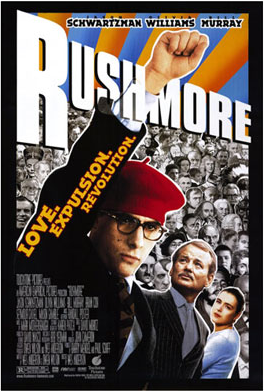
2. Rushmore (1998)


Wes Anderson's second feature-length film, "Rushmore," easily ranks second on my list.  Of course I admire all Wes Anderson projects-- all the way from "Bottle Rocket" (1996) to "Fantastic Mr. Fox" (2009)-- but "Rushmore" never fails to make me cry yet feel genuinely happy in the end.
The Film centers on Max Fischer, an eccentric fifteen year-old, and his relationships with Herman Blume (Bill Murray), a snobby, rich industrialist, and Rosemary Cross (Olivia Williams), an elementary school teacher at Rushmore Academy (where Max is a student) with whom both Max and Herman are in love.  Max finds greater success in extracurricular activities than academics, yet he is completely devoted to Rushmore.  He becomes close friends with Herman Blume, finding him inspiring, as well as becomes infatuated with Ms. Cross and proceeds to make attempts at impressing her and attracting her attention in any way.  However, due to one of his plans, Max is ultimately expelled from Rushmore, forcing him to attend public school.  Without giving the story away, the film continues to follow Max, spotlighting the way he adapts to his new school and the realizations he makes about Herman Blume, Rosemary Cross, life, and, most importantly, himself while fostering his talent as a playwright.
Everything about this film is ideal-- the casting, the screenwriting, the soundtrack, etc.  This is one of my top "go-to" films after having a bad day; the story and characters are so real, and the film succeeds in engaging the viewer without being overwhelmingly dramatic or comical--though "Rushmore" is most definitely hysterical, but in a "down-to-earth" sort of way.  Much like I felt after watching "The English Patient" for the first time, after viewing "Rushmore," I knew that it would be a film that I kept by my side for the rest of my life.  I always recommend it to friends, for it is only 93 minutes and is, I believe, a film that anyone can appreciate if given the chance.
The soundtrack is certainly one of the movie's strongest points; Mark Mothersbaugh is a musical genius, and each of the songs selected for every Anderson film soundtrack, especially "Rushmore," is perfect.  The scene in which Max plays Yves Montand's "Rue St. Vincent" in an attempt to almost-seduce his teacher is simultaneously comical and poignant, and the final song before the credits, "Ooh La La" (The Faces), always makes me smile, for it plays during the final scene of the film where all conflicts are resolved and all of the characters experience a moment of collective contentment.
While I feel that Wes Anderson and Jason Schwartzman should have their separate identities, the two really do go together (for me) because of this movie, as well as the fact that it launched Schwartzman's career.  While Schwartzman has not been involved in all of Anderson's projects, I believe that my connection with Wes Anderson's films can be attributed to the recurring collaborators: Angelica Huston, Bill Murray, Mark Mothersbaugh, Luke Wilson, Owen Wilson, Kuman Pallana, and so forth.  This creates a feeling of familiarity that builds a relationship with the viewer, making one feel like part of "the family."
When "The Darjeeling Limited" (2007) was released in Dallas (along with the short into film, "Hotel Chevalier"), I attended the premiere and Q&A session for the film, which Jason Schwartzman attended.  Schwartzman contributed as a writer (as well as an actor) along with Anderson and Roman Coppola, Schwartzman's cousin.  Schwartzman discussed the experience of filming the feature on an actual moving train as well as shared some insight on the writing process.  "The Darjeeling Limited" features an exquisite soundtrack and brilliant cast--like all Anderson films.  But the film demonstrates the profound effect of color through clothing, landscapes, and people, making the film far more visually striking than all preceding Wes Anderson projects.  Yet I maintain that Wes Anderson has an unparalleled talent in writing and directing, which is responsible for his large and dedicated following of which I am proud to be a part.

3. Le Fabuleux Destin d'Amélie Poulain (2001)


As a French major and French film enthusiast, "Le Fabuleux Destin d'Amélie Poulain" (better known as "Amélie") is a relatively unoriginal pick for a favorite film, but, honestly, who can deny its geniusness?  Jean-Pierre Jeunet is a mastermind of writing and directing, creating heartfelt stories and happy endings amid the bizarre and surreal events that accelerate the film.  Like Wes Anderson, Jeunet has recurring collaborators, making a team composed of fantastic actors and cinematographers (i.e. Dominique Pinon, Rufus & Ticky Holgado, Jean-Claude Dreyfus, Darius Khondki, and Bruno Delbonnel) as well as a brilliant editor, Hervé Schneid, and set designer, Aline Bonetto.  Most American moviegoers would recognize Audrey Tautou for her role as Sophie Neveu in "The Da Vinci Code" or, if they ventured to independent theaters, "Coco Avant Chanel" in which she played the title role, Coco Chanel.  After winning the César Award for "Most Promising Actress for her role in "Vénus beauté (institut)" in 1999, Tautou was casted for the title role of Jeunet's "Amélie," which was released in 2001.
"Amélie" follows a shy waitress in the district of Monmartre in Paris as she performs little acts of kindness to change and improve the lives of others while also figuring out her own life.  Amélie was mistakenly diagnosed with a heart defect as a child, forcing her parents to home-school her and, thus, separate her from other children, isolating her from the world.  At the age of six, Amélie's mother dies in a freak accident, after which her father dedicates his life to creating a memorial in their garden for his late wife.  Even more alone than before, Amélie confronts her solitude with her active imagination.  The story fast-forwards, and we find Amélie as a young woman who has experienced several failed romantic relationships and, as a response, immerses herself in life's simple pleasures.  One evening, Amélie finds a metal box behind a bathroom tile and becomes resolved to return it to its rightful owner.  Amélie meets several characters along the way, including Raymond Dufayel, a painter with a brittle bone condition, who assists Amélie in tracking down Dominique Bretodeau, the owner of the box.  After successfully, yet anonymously, returning the box, Amélie is inspired to continue with these deeds of kindness, for she finds happiness in her actions.  The film continues to follow Amélie on her journey of personal growth as she not only makes other people happy but also finds love for herself.
The film is a treasure and truly sincere; it is unique--to say the least--and makes even the most mundane details of the everyday seem magical and captivating, which, I believe, makes "Amélie" so special.  It is a "feel-good" film on a completely different level than all others.  Rather than feeling uncomfortable and disoriented by the surreal style of filming and the eccentric visual effects, "Amélie" invites and embraces the viewer, bridging an intimate connection between Amélie's and the viewer's subsequent self-contentment.
Other Jeunet films that I adore are: "La Cité des enfants perdus" (1995) and "Un long dimanche de fiançailles" (2004).  "La Cité des enfants perdus" is a dark, fantasy film while "Un long dimanche de fiançailles" tells the romantic tale of a woman (Audrey Tautou) in search of her lover who went missing during World War I.  Although "Un long dimanche de fiançailles" is more morbid and heart wrenching than Jeunet's other films, it still captures the same determination and passion for which Jeunet is known.  Jeunet recently released the film "Micmacs," which has been well received and enjoyed by moviegoers and critics alike, and is certainly on my must-see list for the summer.

4. 2 Days in Paris (2007)


"2 Days in Paris" is a Julie Delpy project in every sense; Delpy is the director, producer, writer, narrator, star, editor, and composer of the film.  Though it was not Delpy's directorial debut, "2 Days in Paris" achieved a fair amount of success in the United States in comparison to her earlier projects ("Blah Blah Blah" (1995) and "Looking for Jimmy" (2002)).  The daughter of notable French actors Marie Pillet and Albert Delpy, Julie Delpy is best known in the United States for her role alongside Ethan Hawke in "Before Sunrise" (1995) and its sequel, "Before Sunset" (2004), for which Delpy co-wrote the screenplay.  I adore both "Before Sunrise" and "Before Sunset," but I must say that one must have a good deal of patience, for each of these films consist of a single conversation that lasts from beginning to end with limited or little "action"-- for lack of a better term.  Some find the films boring; I, on the other hand, see them as chances to truly get to know the two characters, a limited opportunity in film.  By the end of the movies, you know the characters inside and out-- their hopes, dreams, heartbreaks, quirks, and so forth.  In "2 Days in Paris," the opportunity for such a bond between viewer and character arises once again, yet Delpy adds the welcomed element of comedy with the help of co-star Adam Goldberg.
Julie Delpy's character, Marion, narrates "2 Days in Paris," a story about Marion, a French photographer, who is returning from a romantic trip to Venice with her American boyfriend, Jack (Goldberg), and plans to spend two days in Paris with Jack before heading back to New York.  Marion is assertive yet insecure while Jack is neurotic, a hypochondriac, and, as it turns out, insecure as well.  In addition to the conflicts that arise from cultural differences and clashes, the couple is constantly running into Marion's ex-boyfriends and -lovers with whom, to Jack's surprise, Marion is still friendly and is in contact.  The film follows these encounters and the way in which they impact Jack and Marion's relationship, which has its ups and downs throughout the movie.
While implementing humor to "spice up" the story, "2 Days in Paris" remains a deep and thoughtful examination of modern relationships and love, keeping the film as real and "down-to-earth" as possible, which, I feel, is the reason for its success.  Delpy and Goldberg are a fun and very attractive pair, which could be attributed to their past romance as well as the fact that they are both phenomenal actors--and, in my opinion, under appreciated and overlooked in cinema.  On another personal note, I really love the sound of Julie Delpy's voice; it is so distinctive, sincere, and reflective, and she narrates the film as if relating the story to a close friend, making me feel like I know her on a personal level rather than merely admiring her from the comforts of my couch.  In 2009, Delpy released another film that she wrote, directed, produced, composed, etc, "The Countess," which tells the story of Erzebet Báthory, a powerful and fearsome Hungarian countess.  Countess Báthory falls in love with a younger man whose father does not approve of their relationship and leads the Countess to believe that his son no longer loves her.  This heartbreak forces the Countess on a murderous rampage, taking revenge on the beauty of the youth and believing that the blood of virgins will preserve her beauty.  It is a dark and heartbreaking story that is beautifully interpreted and manifested by Julie Delpy, who portrays the Countess.  Delpy shows the versatility of not only her filming and writing technique but also her talents as an actress.
Adam Goldberg is also one of my favorite actors.  Best known for his role in "Dazed and Confused" (1993), "Saving Private Ryan" (1998), and "How to Lose a Guy in 10 Days" (2003), Adam Goldberg, like Delpy, is also a director, producer, actor, and musician.  His current music group, "LANDy," is an interesting and entertaining project, and their debut album "Eros and Omissions" was released this past year ("BFF!" is a fantastic song).
Returning to "2 Days in Paris," I would like to bring this commentary to a close with the closing monologue of the film, which is quite poignant and well written.  It will certainly be best appreciated after viewing the film, but these words give a potential viewer a good idea of the depth this film reaches.


Marion: "It always fascinated me how people go from loving you madly to nothing at all, nothing. It hurts so much. When I feel someone is going to leave me, I have a tendency to break up first before I hear the whole thing. Here it is. One more, one less. Another wasted love story. I really love this one. When I think that it's over, that I'll never see him again like this... well yes, I'll bump into him, we'll meet our new boyfriend and girlfriend, act as if we had never been together, then we'll slowly think of each other less and less until we forget each other completely. Almost. Always the same for me. Break up, break down. Drink up, fool around. Meet one guy, then another, f*** around. Forget the one and only. Then after a few months of total emptiness, start again to look for true love, desperately look everywhere and after two years of loneliness, meet a new love and swear it is the one until that one is gone as well. There's a moment in life where you can't recover anymore from another break-up. And even if this person bugs you sixty percent of the time, well, you still can't live without him. And even if he wakes you up every day by sneezing right into your face, well, you love his sneezes more than anyone else's kisses."


5. Moulin Rouge! (2001)


"Moulin Rouge!" is the final film in Baz Luhrmann's "Red Curtain Triology," which began with "Strictly Ballroom" (1992) and was followed by "William Shakespeare's Romeo + Juliet" (1996).  Luhrmann's method of filming and storytelling are quite revolutionary, providing a clear theme in each of the films in the trilogy: dancing ("Strictly Ballroom"), poetry ("Romeo + Juliet"), and music ("Moulin Rouge!").  Heavily influenced by Italian opera and Bollywood cinema, Luhrmann developed his signature style, which included swirling camera motion, wild cutting, and extreme close-ups.
"Moulin Rouge!" is inspired by Guiseppe Verdi's opera "La Traviata" (coincidentally my favorite opera even before the release of "Moulin Rouge!") and tells the story of Christian (Ewan McGregor), an English poet and writer, who arrives in Paris in 1899, settles in the quarter of Montmartre, and pursues his writing career.  He falls in love with Satine, an actress and courtesan at the Moulin Rouge, who ultimately dies, as we learn at the very beginning of the film.  "Moulin Rouge!" follows the story of their passionate love and the transformation of the Moulin Rouge into a theater, made possible by the financial investment of the Duke (Richard Roxburgh), the villain of the story.  Infused with well-known popular music, "Moulin Rouge!" is a move-musical that stands apart from all the rest.  With song like Elton John's "Your Song," The Police's "Roxanne," and Queen's "The Show Must Go On," it is impossible to keep from singing, especially upon hearing the beautiful interpretations of these classics.  "Elephant Love Medley" is the first song shared between Christian and Satine and is both catchy and heartfelt; it is comprised of songs like "All You Need is Love" (The Beatles), "Pride (In the Name of Love)" (U2), "Don't Leave Me This Way" (Harold Melvin & the Blue Notes), "Silly Love Songs" (Paul McCartney and Wings), and "Heroes" (David Bowie), to name a few. "Come What May" is known as the lovers' "secret song" in the film and is the movie's only original song, which went on to receive a Golden Globe nomination and is included on the AFI's 100 Year, 100 Songs list.  It is an intense and emotional ballad that is sung twice in the film.  However, the soundtrack, which consists of two volumes, is fantastic in general--a must buy for any music lover.
How do I begin to explain what "Moulin Rouge!" means to me?  I was eleven when the film was released, and my mother, thinking I was too young decided it would be best to refrain from seeing it in theaters-- much to my dismay.  However, soon after "Moulin Rouge!" was released on video, my mother, younger sister, and I watched the film and were left speechless-- jaws dropped, tears flooding down our faces, and hearts racing.  Until this day, we still speak about the film as if it were a life-changing experience, which it truly was.  My sister and I were immediately obsessed; I bought the sheet music and [poorly] sang all of the songs, and my sister would type up the script word for word on a typewriter that we bought shortly after being inspired by Christian's character in the film.  For my sister's ninth birthday party, the house was decorated with screen-caps from the movie, and all of the girls were encouraged to dress up like the Moulin Rouge dancers-- certainly a nightmare to any parent other than my mother and father.  Most of my friends from middle school and the majority of my high school-friends know me for my love for "Moulin Rouge!," and I am proud to be responsible for their conversions into part of the cult.  In seventh grade, a few years after my love affair had begun, my class took a trip to New York City, and one of my fondest memories from the trip was walking through the city at night, arm-in-arm with my friend, Aviva, singing "Your Song," "Elephant Love Medley," and "Come What May" at the top of our lungs without a care in the world.  My best friend Laura and I also share a love for "Moulin Rouge!," and we never hesitate to text one another when we are reminded of the film or are watching it, which I often am.  My sister and I can still recite the film from start to finish, including its songs, and every time I watch "Moulin Rouge!," it brings me back to the first time all over again, and I never cry any less than the time before.
Nicole Kidman won the Golden Globe for "Best Actress" and is stunning both as an actress and as a singer, which she had never attempted at before starring in "Moulin Rouge!"  Ewan McGregor is irresistable with an equally remarkable voice and his overwhelming sincerity.  In addition to Kidman and McGregor, the casting choices as a whole could not have been better; Jim Broadbent ("Iris," "Bridget Jones' Diary") plays Harold Zidler, the owner of the Moulin Rouge, and John Leguizamo ("Carlito's Way," "Romeo + Juliet") takes the role of Henri de Toulouse-Lautrec.
One can see the phenomenal imagination of Baz Luhrmann at work throughout the film, fashioning a masterpiece of cinema, dance, and music that captures the hearts of viewers of any age, forming an intimate bond that is sure to last a lifetime.

"The greatest thing you'll ever learn is just to love and be loved in return."


6. West Side Story (1961)
7. Les Chansons d'Amour (2007)
8. Rear Window (1954)
9. Jeux d'Enfants (2003)
10. Basic Instinct (1992)
11. Annie Hall (1977)
12. The Way We Were (1973) 
13. Les Parapluies de Cherbourg (1964)
14. Bridget Jones' Diary (2001)
15. The Sound of Music (1965)